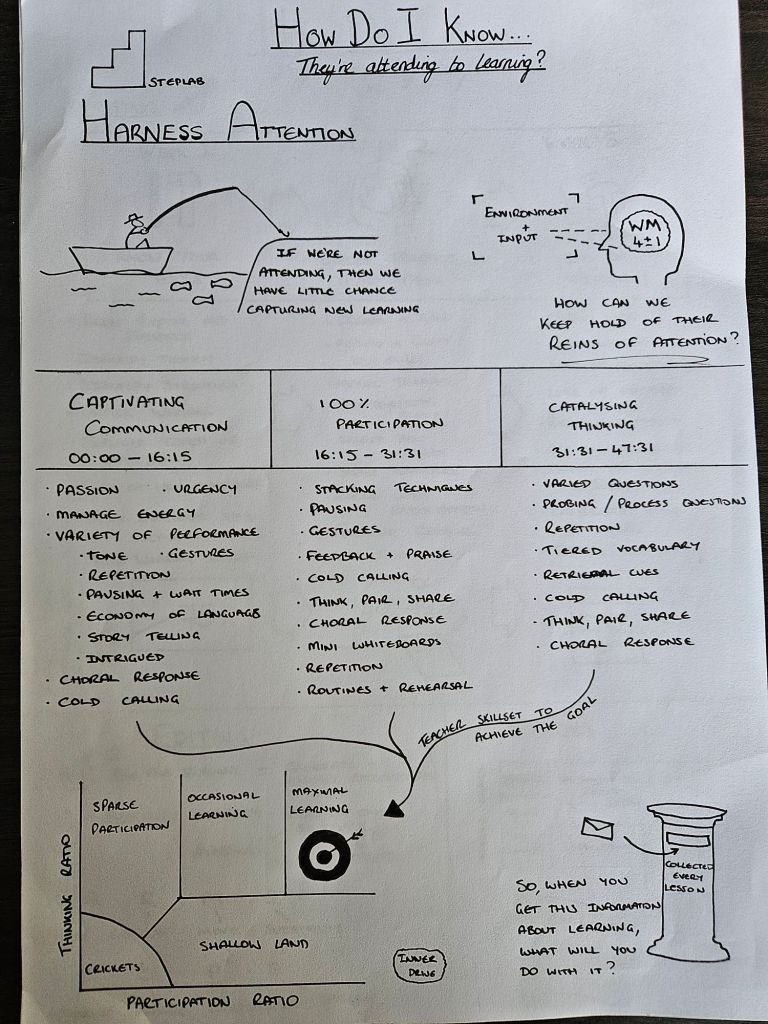
In the classroom, attention has to be everything. Without it, meaningful and purposeful learning can’t take place. As part of our How Do I Know? series (see my previous post on How Do I Know? Crucial Question for Teachers and Leaders) , the release of Steplab’s Video couldn’t have come at a better time. We were really zooming in, asking How Do We Actually Know they are learning, not passive or distracted, but actually listening, concentrating and thinking.
Steplab’s video Great Teaching Unpacked: Episode 1 – Harnessing Attention, so clearly shows if students aren’t attending, they have little chance of capturing new learning — no matter how great the lesson plan is. And for us, developing our pedagogical armoury, keeping hold of the reins of attention in every moment, in every lesson, is fundamental.
The Three Phases of Attention: From Captivation to Thinking
The video breaks the journey of student attention into three clear and progressive phases. Each is essential for building not just engagement, but memory and understanding.
1. Captivating Communication (00:00 – 16:15)
Here, teachers hook attention through energy, storytelling, and purposeful performance.
Key strategies include:
- Passion and urgency
- Variety of tone and gestures
- Repetition and wait times
- Storytelling and intrigue
- Cold calling and choral response
If we don’t spark attention early, we lose the chance to plant the seeds of learning.
2. 100% Participation (16:15 – 31:31)
Once students are engaged, we must actively involve everyone. Learning is not a spectator sport.
Classroom techniques include:
- Think, pair, share
- Mini whiteboards
- Cold calling
- Choral response
- Routines and rehearsal
- Stacking techniques and feedback
The goal is not just attention, but working memory activation through active participation.
3. Catalysing Thinking (31:31 – 47:31)
The final segment is about deep thinking. This is how learning can more reliability and likely stick.
- Varied and probing questions
- Tiered vocabulary and retrieval cues
- Repetition and deliberate practice
- Structured opportunities to recall and apply
When both participation and thinking are high, we move into the zone of optimal learning.
Why This Was Crucial CPD for Our School
This session formed a core part of our school’s “How Do I Know?” CPD series — focused on answering one vital question:
How do we know students are truly attending to learning?
This resource offered us a shared language and a powerful framework to explore the range of attention strategies we use; how those strategies work in practice; and what adaptations we might need to go even further.
It wasn’t just about adding new tools — it was about reflecting on what’s working, what’s missing, and how to move from good to great.
We reflected together as a staff from the outside looking in, asking critically whether our attention strategies were consistent and intentional; were we really seeing 100% cognitive engagement; and were routines embedded deeply enough to be automatic for all.
“How Do I Know?” is more than a question — it’s a mindset we’re building into every classroom interaction.
Harnessing attention is not about performance for performance’s sake. It’s about the precision and consistency of our techniques that hold students in the learning zone.
You can have all the right equipment for fishing, but if you’re not checking your cast, you won’t know why and how it’s not working.
Whether you’re just starting out or refining your craft, unpicking this episode can give a practical roadmap to building attention, increasing participation, and embedding learning that lasts.
Watch the episode here:
Great Teaching Unpacked: Episode 1 – Harnessing Attention
Discover more from Teacher Out Loud
Subscribe to get the latest posts sent to your email.
 Teacher Out Loud