When we talk about a school’s curriculum, the mind often jumps straight to subjects — the programmes of study, the knowledge maps, the progression models. But the true curriculum of a school extends far beyond the timetable. It is every experience, opportunity, and encounter a child has within the life of the school. It is, in essence, the school’s holistic education offer — the lived embodiment of its vision.
Vision First: The Anchor of Every Decision
A school’s vision is more than a slogan on a website or a line in a policy document. When genuinely defined, it becomes the heartbeat of the school — shaping decisions, inspiring practice, and aligning every element of provision.
To be meaningful (in both understanding and application), a vision must be:
Clear and concise – simple enough to communicate, powerful enough to inspire.
Truly defined – not just in words, but in shared understanding and action.
Lived by all – every member of the community can see themselves within it and knows how their work contributes to its fulfilment.
When the vision is clear and etched into the workings of the school, every curriculum decision, from subject intent to enrichment, has a direction.
Staff can confidently ask, “How does this help us realise and actualise our vision for our children?” That question transforms planning from a compliance task into a shared moral purpose.
All encompassing
If we are to nurture both what I believe to be scholarship and personaldevelopment, our curriculum must reflect the full range of what it means to be educated at our school. A holistic curriculum deliberately develops the whole child, ensuring that the pursuit of academic excellence is complemented by growth in character, creativity, and wellbeing. It supports the intention for high standards across every aspect of school, including curricula on behaviour and personal development.
To achieve this, it helps to think of our curriculum in holistic strands – interconnected domains that together form the web of our educational offer.
For example (although there are many options that are better suited to the context and priorities of each school):
Personal Development – character, relationships, values, responsibility
Health & Wellbeing – physical and mental health, resilience, belonging
Aspirations – ambition, self-belief, global citizenship, cultural capital
Knowledge & Skills – substantive and disciplinary understanding within subjects, applied meaningfully beyond them
Within each of these strands (as an example) sit our subject curricula: each with its own integrity and depth, but all connected through the school’s wider vision and values. Science and art, for example, both nurture curiosity and creativity naturally, but thinking carefully about how subjects like Maths and History achieve this allow for more nuanced thinking. More examples like PE and PSHE both build resilience and teamwork; history and English both strengthen communication and understanding of humanity, and so on.
This interconnectedness is what transforms a collection of subjects into a coherent, holistic web — a curriculum that is more than the sum of its parts (a term from Aristotle that rings so true to me).
The Interdisciplinary Web: Weaving It All Together
When designed with intentional links across these strands, the curriculum becomes a powerful tool for interdisciplinary learning. Children begin to see connections: how knowledge in one domain informs understanding in another, how values are lived out through action, and how their learning equips them to shape the world around them.
This web-like structure doesn’t dilute subject rigour; rather, it strengthens it. When children understand the purpose of their learning and how it connects to the school’s vision and their own aspirations, motivation and depth of understanding grow.
Bringing It All Back to the Child
Ultimately, a truly holistic curriculum answers one question:
“What do we want this child to become… and how will every experience in school help them get there?”
In its fullest sense, it is the blueprint of the school’s badge.
When every strand of the curriculum, every policy, and every relationship is woven from the same vision, we move from delivering lessons to shaping lives. The curriculum becomes not just what we teach, but who we are.
You can have all the right equipment for fishing, but if you’re not checking your cast, you won’t know why and how it’s not working.
In the classroom, attention has to be everything. Without it, meaningful and purposeful learning can’t take place. As part of our How Do I Know? series (see my previous post on How Do I Know? Crucial Question for Teachers and Leaders) , the release of Steplab’s Video couldn’t have come at a better time. We were really zooming in, asking How Do We Actually Know they are learning, not passive or distracted, but actually listening, concentrating and thinking.
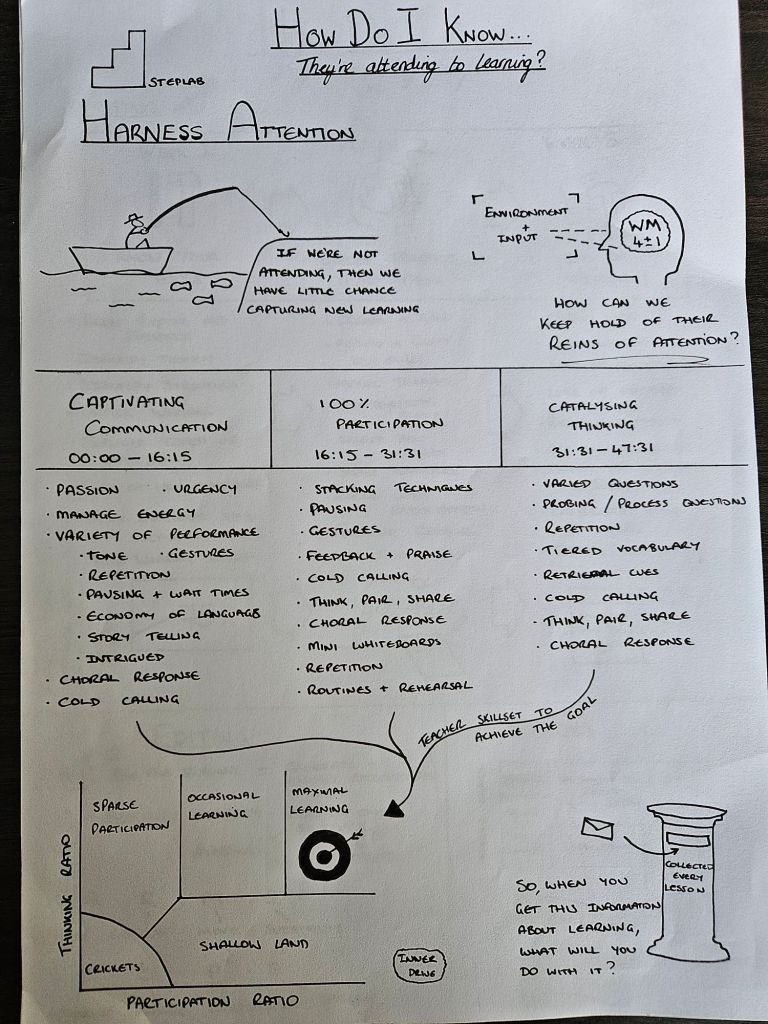
Steplab’s video Great Teaching Unpacked: Episode 1 – Harnessing Attention, so clearly shows if students aren’t attending, they have little chance of capturing new learning — no matter how great the lesson plan is. And for us, developing our pedagogical armoury, keeping hold of the reins of attention in every moment, in every lesson, is fundamental.
The Three Phases of Attention: From Captivation to Thinking
The video breaks the journey of student attention into three clear and progressive phases. Each is essential for building not just engagement, but memory and understanding.
1. Captivating Communication (00:00 – 16:15)
Here, teachers hook attention through energy, storytelling, and purposeful performance.
Key strategies include:
Passion and urgency
Variety of tone and gestures
Repetition and wait times
Storytelling and intrigue
Cold calling and choral response
If we don’t spark attention early, we lose the chance to plant the seeds of learning.
2. 100% Participation (16:15 – 31:31)
Once students are engaged, we must actively involve everyone. Learning is not a spectator sport.
Classroom techniques include:
Think, pair, share
Mini whiteboards
Cold calling
Choral response
Routines and rehearsal
Stacking techniques and feedback
The goal is not just attention, but working memory activation through active participation.
3. Catalysing Thinking (31:31 – 47:31)
The final segment is about deep thinking. This is how learning can more reliability and likely stick.
Varied and probing questions
Tiered vocabulary and retrieval cues
Repetition and deliberate practice
Structured opportunities to recall and apply
When both participation and thinking are high, we move into the zone of optimal learning.
Why This Was Crucial CPD for Our School
This session formed a core part of our school’s “How Do I Know?” CPD series — focused on answering one vital question: How do we know students are truly attending to learning?
This resource offered us a shared language and a powerful framework to explore the range of attention strategies we use; how those strategies work in practice; and what adaptations we might need to go even further.
It wasn’t just about adding new tools — it was about reflecting on what’s working, what’s missing, and how to move from good to great.
We reflected together as a staff from the outside looking in, asking critically whether our attention strategies were consistent and intentional; were we really seeing 100% cognitive engagement; and were routines embedded deeply enough to be automatic for all.
“How Do I Know?” is more than a question — it’s a mindset we’re building into every classroom interaction.
Harnessing attention is not about performance for performance’s sake. It’s about the precision and consistency of our techniques that hold students in the learning zone.
You can have all the right equipment for fishing, but if you’re not checking your cast, you won’t know why and how it’s not working.
Whether you’re just starting out or refining your craft, unpicking this episode can give a practical roadmap to building attention, increasing participation, and embedding learning that lasts.
The pencils are down. The papers are packed away. SATs are over. So, what now? For Year 6 teachers, this post-SATs season is a rare and precious window. It’s not an ending, but a golden opportunity: a time to celebrate how far your pupils have come, prepare them for the journey ahead, and reflect on your own practice as a teacher. It’s also a space to breathe, recalibrate, and rediscover the parts of the curriculum, and the classroom, that make this job so rich and rewarding.
Although there are still other deadlines like timetable variations, special considerations, report writing, moderation, this blog isn’t intended to go in-depth in these areas – it’s to remind us all to stop, reflect and pace yourselves accordingly.
For specific advice and support on any of the above, feel free to get in contact with me.
See my Year 6 Blog for a starting point anyone knew or wanting a refresh
1. Celebrate, Embrace and Reflect
Before anything else, pause and celebrate. Your class has come through a high-pressure, high-stakes period, and they’ve done so with courage. Whether your pupils flew through the papers or found parts of them tough, each one deserves recognition for showing up, trying hard, and pushing themselves. That effort matters more than any scaled score. Bring the joy and meaning back into your classroom through small, thoughtful celebrations. These create core memories and affirm every child’s sense of self-worth.
Ideas to try:
Create personalised certificates like “Most Inquisitive Mind,” “Kindest Friend,” or “Quiet Strength.”
Build a Wall of Greatness, where each child writes something they’re proud of and a compliment for a classmate.
Let children write letters to their future Year 7 selves, including advice, dreams, and affirmations.
Host a “Proud Moments” circle time where everyone shares one challenge they overcame this year.
“The thanks I Owe” – get children to think of someone or something that has really helped them.
2. Writing Moderation: Finishing Strong
As SATs wrap up, writing moderation moves into focus. While it can feel administrative (and I know that as being on both sides of the table as LA moderator for a number of years as well as helping write the commentaries that go for new exemplifications each year, VS my career as Y6 teacher to Headteacher), this can still be a brilliant opportunity to champion the power of writing and celebrate your young authors.
Make the process more engaging, supportive, and edit-focused. The goal isn’t just evidence collection – it’s to help children see themselves as real writers.
Ideas to support moderation and engagement:
Review your collection of work against the TAF – what statement is missing or needs more; is this achieved through editing and needs a new writing opportunity?
Turn your classroom into a “Writer’s review” with a significant focus on editing and redrafting current pieces.
Create Author’s Afternoons, where children read their polished pieces aloud to other classes or parents, and welcome feedback.
Host writing conferences in groups and 1:1 with you and others.
3. Keep It Broad – But Think Beyond the Curriculum
With SATs done, you can fully re-embrace the wider curriculum – those enriching, cross-curricular experiences that often get squeezed out. But it’s also the perfect time to think beyond the subjects and towards real-life readiness.
Secondary transition can feel daunting, so build in practical, social, and emotional preparation. These experiences give pupils confidence and reduce anxiety before the big leap.
Ideas for transition readiness:
Teach how to use a planner or organiser by simulating a secondary timetable.
Run tie-tying relays: fun, competitive, and genuinely helpful.
Invite ex-pupils in to speak about life at secondary and answer questions.
Explore secondary roles (like form tutors, pastoral leads) and role-play asking for help or joining clubs.
PSHE activities to build self-awareness and resilience:
“What I’m Proud Of”
“How I Handle Worry”
“What I Want My Friends to Know About Me”
Use mask-making or silhouette art to show emotions – how we appear on the outside vs how we feel inside.
Hold circle times on confidence, friendships, and change.
These sessions empower your pupils to walk into Year 7 with life skills, emotional strength, and a strong sense of self.
4. Learn from Year 6, Plan for Year 5
Every Year 6 cohort teaches us something new – about pacing, pedagogy, or pastoral care. The final term is full of “If only I’d started that sooner…” realisations. Capture them now while they’re fresh and feed them into your Year 5 plans.
This is how we refine our craft, not just through outcomes, but through insight.
Reflect and act:
Employ your best approach to behaviour and routines for a crucial effective start.
If you wished you knew more about individuals, then work with Y5 teachers and parents now.
If you discovered a great group editing strategy, build it into the Year 5 writing cycle earlier in the year.
If pupils gained independence late, introduce class jobs or planners earlier in the timetable.
If weekly wellbeing check-ins helped settle your class, implement them in September for Year 5s.
If scaffolded maths journals boosted confidence, start those in the autumn term.
Create a simple “What I’ve Learnt from Year 6” document to share with colleagues or future you.
These aren’t just tweaks—they’re investments in stronger starts and smoother learning journeys.
5. Think September—Now
While it’s tempting to slow down completely, the post-SATs calm is actually a fantastic time to plan for September. Think of it as a gift to your future self – the one who deserves a stress-free summer.
Reflect on your own September start this year. What felt smooth? What needed more structure or clarity? Use this breathing space to prepare practical elements and make your next transition even better.
Small actions now for a better September:
Sketch a new classroom layout that supports independence and calm.
Tweak or rewrite your welcome letter, “About Me” slides, or class handbook.
Draft first-week plans with a balance of routines, relationship-building, and engaging learning.
Plan or prep your first display/ working wall – maybe one that celebrates identity or introduces key values.
SEND strategies and scaffolds have ready-made and available for those lessons you know most likely need them.
Start a September folder with resource lists, lesson ideas, and first-week activities.
Even 30–60 minutes a week now can save you from a panicked August rush – and give your pupils a smoother, more confident start.
Protecting Your Wellbeing: Breathe, Recharge, and Rebalance
The post-SATs period isn’t just about the children – it’s about you too. After a term that’s emotionally charged and full of pressure, it’s essential to give yourself space to recover. You’ve led with energy, empathy, and determination; now you need time to breathe and recharge.
Take a moment to step back, breathe deeply, and protect your energy. Your wellbeing matters—not just for your sake, but because a calm, grounded teacher helps children feel safe and valued too.
Once you’ve given yourself time to recover, invest your energy wisely:
Block out time to complete reports in a focused, realistic way.
Schedule space to attend and enjoy end-of-year events without burnout.
Set time aside to connect with parents, reflect on shared journeys, and celebrate successes.
Prepare your transition work and September plans so that when summer truly arrives, you can relax knowing the groundwork is already done.
Protect your peace now, so you can truly unwind, reset, and return in the autumn with clarity and purpose.
Final Thoughts
So, what now?
Now is the time to:
Celebrate how far your class has come.
Prepare them not just for tests, but for life.
Reflect on your own teaching and your growth this year.
Refine your plans for the learners still to come.
And most of all – enjoy this precious chapter with your Year 6 pupils.
This isn’t the end of the journey – it’s the scenic stretch after the climb. You’ve made it through the hard part. Now it’s time to look around, appreciate the view, and help your pupils map out their next adventure.
You’ve earned it. They’ve earned it. And your summer-self will thank you.
In the ancient story of Exodus, the Egyptians enslaved the Israelites, not because they were weak but because they were strong. They feared that, if left free, they might grow, multiply, and become powerful that one day, they may rule over the Egyptians. Their solution: suppress their potential through control and forced labour. This meant reducing and inhibiting the potential of mothers, fathers and children all down to a lack of trust, fear and/or an ego of ultimate power. I find this message very inspiring as I reflect on systems and my own experiences where I have witnessed potential being limited whether that has been intentional or not. Nonetheless, it’s an important message that encourages us to question ourselves as teachers and leaders how guided are we by our moral compass (see my other blog Moral Purpose) where we uphold transparency, honesty and integrity.
The Pharaoh Complex: Leadership Rooted in Fear
At its core, the Egyptian leadership was driven by fear: fear of being challenged, of losing power, of what others might become. This “Pharaoh complex” is still alive, hopefully less so by decisions ruled by fear of power, but a fear of losing face, pride or adequate recognition when people withhold resources, information or intenstionally misguide. This could be within a classroom, across departments and even across schools, MATs and Local Authorities.
Some examples might be:
A teacher labels a struggling child as a problem, rather than asking what barriers are blocking their growth.
A system denies equal and equitable opportunities.
A leader resists change and innovation, not because the ideas lack merit, but because they didn’t originate from them, or “things have always been done this way” (see my blog Dogma – a call for change)
In all these cases, the common thread shouldn’t be interpreted that there isn’t potential, but that it has not been properly/ truly actualised.
Actualisation: The True Role of Teachers and Leaders
True leadership isn’t about containment – it’s about cultivation. Teachers and leaders hold the profound responsibility of helping others move from potential to actualisation; the realisation of what they are capable of becoming.
In psychological terms, this is often linked to the idea of self-actualisation, the highest point in Maslow’s hierarchy of needs. It’s where creativity, purpose, and meaning flourish, but only when basic needs, safety, and belonging have been met.
Leaders and educators must ask: are we creating environments that free people, or environments that quietly shackle them?
Disadvantaged: Socio-economic deprivation; SEND; predetermined aspirations; all who may be sucespitble to potential discourse
Nowhere is this challenge more urgent than in classrooms. ChIldren without love and championing light run the risk of feeling like their potential has been predetermined, and this is dangerous. Not only dangerous to the fulfillment of the individual but dangerous for our future in a higher order sense: an absence of one’s potential could be what hinders our overall trajectory as a civilisation.
Some examples of this could be the following:
Children who come to school hungry or tired.
Children who have been told by the world that they are not enough.
Children who have learned to survive, not to dream.
These children often exhibit behaviors such as defiance, lack of motivation, truancy, but more often, these are symptoms of unmet needs, unspoken trauma, or unrecognised brilliance. The tragedy is not in their struggle – it is in the failure to see beyond it.
What they need isn’t just curriculum – they need connection, they need to know you care what they say.
Not just discipline but dignity.
Not just management but mentorship.
Purpose vs. Performance: What Really Unlocks Potential?
At the heart of realising potential lies a deeper question: what is driving the effort to actualise it? Is it rooted in moral purpose – a genuine desire to see others flourish? Or is it driven by performance systems – data, rankings, performance reviews, and outputs mistaken for outcomes?
This distinction is crucial.
When we teach or lead with moral purpose (when we genuinely want children, or team, to become their bestween) we use data as a mirror to the individual, not a measure of worth. Data can become a way to listen more deeply, to understand who needs what and why. In these spaces:
Assessment supports learning rather than dictates it.
Progress is personalised, not standardised.
Growth is measured by transformation, not just attainment.
But when data becomes the driver, when metrics replace mission, we risk negating the other aspects of a person’s development; we may begin to track growth so obsessively that we forget to nurture it.
This shift turns potential from a sacred trust into a target to be met. And ironically, it can inhibit the very growth it claims to foster.
This too is a modern form of Pharaoh’s oppression – not through chains and whips, but through dashboards and quotas. The result is the same: a narrowing of what people could become.
To Liberate
A liberating teacher doesn’t ask, “How do I control this child?” but rather, “What does this child need to become their best self?”
A liberating leader doesn’t ask, “How do I maintain authority?” but instead, “How do I create space for others to thrive?”, offering structure and descripive feedback without suffocation, and certainly letting go of ego to make room for growth.
The Moral Choice in Leadership
We are all, at some point, in positions of power over others – whether as teachers, mentors, parents, or managers. In each of those moments, we face a choice:
Will we fear others’ potential, or will we help it flourish?
Will we lead from data, or from purpose? And when should one drive the other?
The Egyptians led with fear. They built monuments to control. But the greatest leaders build people, not pyramids. They recognise that power is not in domination, but in liberation and empowerment. Do we truly care what they say so that they know that we care, and do we champion and strive to actualise everyone’s potential, no matter their starting points.
Leadership in education isn’t just a job. It’s a calling – one that demands every part of you. To truly serve a school as its headteacher, you must invest your heart and soul into being the leader your community deserves. Anything less won’t do.
I’ve always believed that to lead well, you must live by your moral compass. For me, that’s always been that “They won’t CARE what you say until they know that you CARE,” That means being honest, even when it’s hard. It means staying loyal to your values, to your team, and most importantly, to the children. It means showing humility – acknowledging when you don’t have all the answers and when others around you do. And above all, it means listening. Truly listening.
Not everything people share with you can be actioned, but everything can be acknowledged. That’s how trust is built. It’s how people begin to believe again in a collective future worth working toward.
When I first walked into our school less than two years ago, we were facing significant challenges. But from day one, I refused to see any problem as unconquerable. Instead, I grounded myself in what matters most – children’s learning and wellbeing. That became the heartbeat of everything. The decisions, the strategy, the conversations. We rebooted culture; enforced high expectations; replaced excuses with solutions; and prioritised regular coaching and feedback to improve teaching and learning. And slowly, we started to turn things around.
It didn’t happen because of me alone. It happened because of us – staff, families, community, and our trust. We rallied around a shared vision. We committed, together, to giving every child the education they deserve. We didn’t settle. We didn’t shy away from hard truths. And we never let go of that deep, burning passion to make it better – for all.
This job is hard. Some days, it feels impossible. But if you stay rooted in what matters, the impossible starts to shift. Things begin to move. Hope takes hold. And what remains, long after the long nights and difficult decisions, is a shared hunger – a relentless drive to keep pushing standards higher and higher. For me, it always comes back to the children. Every action, every plan, every challenge we face must pass that test: does this serve our children well? If the answer is yes, we press on. If not, we rethink.
So to anyone leading a school, or aspiring to: be brave enough to care deeply. Show up with your whole heart. Listen even when you’re tired. Lead with your values and never lose sight of the reason you began this journey in the first place. Because when you give everything to this role with honesty, humility, and passion, what unfolds is powerful. What grows is lasting. And what changes, most of all, are the lives of the children who needed you to care all that much.
How do I know? This question sits at the heart of both effective teaching and school leadership. For teachers, it means ensuring that every child is attending to their learning and securing new knowledge. For leaders, it means asking, How do I know that teaching and learning is of high quality? and How do I know staff understand the next steps in our school’s journey? However, my main focus in this blog is on pupils: How do I know that all children are attending and learning?
Understanding Memory and Attention: The Foundations of Learning
Our exploration began with an in-depth look at Baddeley & Hitch’s working memory model, and the later developed simple model of the mind (Willingham). Understanding this model helped us to refine our approach to lesson design, ensuring that we focus not just on delivering content but on how well children attend to, process, and retain new information.
Baddeley & Hitch’s model (1974) breaks working memory into four components:
The Phonological Loop – Processes and stores verbal information (e.g., spoken instructions, discussion).
The Visuospatial Sketchpad – Handles visual and spatial information (e.g., diagrams, illustrations).
The Episodic Buffer – Integrates information from different sources and connects it to prior knowledge.
The Central Executive – Directs attention and manages cognitive resources, determining what is stored and processed.
This model is fundamental because it shows that working memory is limited, meaning that if we overload it with too much new information at once, learning suffers. This links directly to Willingham’s model of memory, which emphasises that learning is a change in long-term memory. His research supports the idea that for learning to occur:
Working memory must process information effectively before it can be stored in long-term memory.
Rehearsal, retrieval, and meaningful connections strengthen memory storage.
Attention is the gatekeeper to learning – if a child isn’t paying attention, nothing enters working memory in the first place.
If we don’t manage cognitive load properly, we risk overwhelming working memory, leading to poor retention and surface-level understanding.
So, We Must Ensure Attention – Dual Coding
This understanding led us to explore Dual Coding Theory (Paivio, 1971), which highlights that learning is more effective when verbal and visual information are processed together. By engaging both the phonological loop (verbal input) and the visuospatial sketchpad (visual input), we maximise the chances of information being encoded into long-term memory.
However, this requires careful design – not all visuals enhance learning. Too much text alongside an image can create split attention, while decorative but irrelevant visuals can add unnecessary cognitive load. Therefore, we must be deliberate in how we present information, ensuring that both channels of attention are activated in a way that supports learning, not distracts from it.
The Key Question: How Do I Know Children Are Attending?
Even with a well-structured lesson that considers cognitive load and dual coding, we cannot assume that all children are fully engaged and processing new knowledge. This leads us to the crucial question:
How do I know that children are actively attending to the learning?
How do I know they are not just passively present, but truly engaging with the material in a way that leads to retention?
These questions set the stage for our next discussion – how we ensure that children not only acquire knowledge but also retain it over time – we referred to Ebbinghaus’ Forgetting curve.
Performance vs. Learning: Why Immediate Success Doesn’t Always Mean Long-Term Retention
A key discussion point for our team was knowing the correct information we are out to get. This meant understanding the distinction between performance and learning, a concept highlighted by Bjork and Soderstrom. Often, as educators, we see a child successfully completing a task in a lesson and assume they have learned it. However, Bjork & Soderstrom argues that performance (what a learner can do in the moment) is not the same as learning (what a student retains and can apply over time).
Performance:
What a child can demonstrate right now in response to instruction.
Often influenced by short-term memory, familiarity, or surface-level understanding.
Can be artificially inflated by scaffolding, worked examples, or teacher-led modeling.
Learning:
A lasting change in long-term memory.
Takes time and is strengthened through retrieval, spaced practice, and application.
Can only be truly assessed after a delay – what can the child recall a week or a month later?
If we mistake performance for learning, we may be misled into thinking our teaching is more effective than it truly is. A student who answers a question correctly in class may forget it by the next lesson. Conversely, a student who struggles initially but engages in effortful retrieval may retain the knowledge for longer. This is why retrieval practice, interleaving, and spaced learning are critical – not just teaching to the moment but designing learning experiences that ensure long-term retention.
Poor Proxies for Learning vs. Good Proxies for Learning
To truly evaluate whether learning has taken place, we need to distinguish between poor proxies (superficial indicators of success) and good proxies (deep indicators of genuine learning). This is where Chiles’ work in The CRAFT of Assessment helped us refine our thinking.
❌ Poor Proxies for Learning (Misleading Indicators)
These are things that might look like learning but don’t guarantee retention or understanding:
❌ Engagement – A lively, interactive classroom is great, but participation doesn’t mean pupils are encoding information into long-term memory. Enthusiasm doesn’t equal retention.
❌ Task Completion – Just because a child completes a worksheet or a written task doesn’t mean they’ve understood or remembered the content. They may have copied, guessed, or relied on short-term recall.
❌ High Scores in Immediate Tests – A pupil who scores well in a test immediately after teaching may not retain the knowledge weeks later. This is why delayed assessments and retrieval are essential.
❌ Classroom Compliance – A well-behaved pupil who looks attentive might not be actively processing the learning. Attention must be measured through responses, questioning, and recall – not just focus.
✅ Good Proxies for Learning (Reliable Indicators)
These are evidence-based ways of knowing whether learning has truly taken place:
✅ Retrieval Practice Success Over Time – If children can recall and apply knowledge in different contexts after a delay, it’s a strong indicator of learning. Techniques like low-stakes quizzes, spaced questioning, and interleaving help assess this.
✅ Application to New Contexts – If children can take knowledge and use it in a new problem or scenario (transfer of learning), it suggests deeper understanding rather than rote memorisation.
✅ Mistakes Followed by Improvement – A child who initially struggles but improves through retrieval and feedback is more likely to have learned than one who got it right immediately but forgets soon after.
✅ Explanation and Justification – If a child can explain why an answer is correct, make connections to prior learning, or teach it to someone else, this indicates secure understanding.
✅ Delayed Recall & Spaced Learning – If a child remembers a concept after days or weeks, rather than just in the lesson, it suggests true retention.
Building a Culture That Values Learning Over Performance
By embedding this understanding into our assessment practices, we are fostering a culture that values deep learning, risk-taking, and feedback. We want students to feel safe making mistakes and recognising struggle as part of the learning process. For more information on this, see Feedback Culture That Needs Feeding blog.
This is why our focus on Rosenshine’s questioning principles, WalkThrus strategies, and TLAC 3.0 techniques is so important. Cold Calling, No Opt Out, Think-Pair-Share, and Show Me Boards all provide real-time insights into whether children are truly attending and processing new knowledge.
Ultimately, our role as educators isn’t just to deliver information—it’s to ensure that information is deeply learned, securely retained, and meaningfully applied. By continually asking, How do I know?, we move beyond surface-level indicators and create a school culture built on genuine, lasting learning.
Practical Strategies for Ensuring High Participation Ratio
A key focus of our discussion was on ensuring that every child is actively participating in their learning, not just a select few. A helpful 2 minute video of Pritesh Raichura demonstrated a predominantly High-Participation Ratio (a link to the three phases of questioning outlined in BunsenBlue blog) where as many children as possible were engaged in cognitive work at any given moment. To achieve this for ourselves, we looked at strategies drawn from Complete the Circuit blog, Rosenshine’s Principles, WalkThrus, and TLAC 3.0 (Teach Like a Champion, Lemov), can decided on these 4 strategies:
Cold Calling
No Opt Out
Think, Pair, Share
Show Me Boards
Each of these strategies ensures that all students are attending to the learning and that we have real-time insight into their understanding.
1. Cold Calling: Eliminating Passive Learning
What it is:
Cold Calling is a structured questioning technique where teachers pose a question before selecting a student to answer, ensuring that all students remain engaged and ready to contribute. It removes the issue of only confident students raising their hands and prevents passive learning.
Why it ensures High Participation Ratio:
Learners know they could be asked at any time, which increases attention.
No child can opt out of the cognitive work; everyone must be thinking.
It reduces the over-reliance on a handful of ‘keen’ pupils.
How it links to “How Do I Know?”
Cold Calling makes attention visible. If students are struggling to answer, it highlights gaps in understanding that we might otherwise miss. It also provides instant formative assessment—are they engaging with the material, or are they coasting?
Practical tip:
Use a pause before calling on a student to ensure all are thinking first.
Vary who is called on – ensure it’s not always the same children.
Normalise mistakes – so pupils don’t fear being wrong.
2. No Opt Out: Holding Every Student Accountable
What it is:
No Opt Out ensures that when a student initially struggles to answer a question, they don’t get to avoid it. Instead, they are guided towards the right answer and then required to repeat the correct response.
Why it ensures High Participation Ratio:
Children can’t disengage or ‘check out’ – they remain accountable for learning.
It creates a culture where struggling is okay, but effort is expected.
Encourages learners to actively listen to their peers’ answers.
How it links to “How Do I Know?”
No Opt Out reveals who truly understands the learning and who is guessing or disengaging. It also reinforces retrieval practice—students are required to recall and articulate key knowledge, strengthening long-term retention.
Practical tip:
When someone doesn’t know an answer, guide them through small scaffolding steps to reach the correct response.
Always return to them to restate the correct answer to reinforce retrieval.
Use partners strategically – if one struggles, let another help, then return to the original student to ensure understanding.
3. Think, Pair, Share: Structured Discussion for Deeper Thinking
What it is:
Think, Pair, Share structures classroom discussions to ensure all students actively process and articulate their thinking. Instead of calling on one student immediately, students first think individually, then discuss with a partner, before finally sharing with the class.
Why it ensures High Participation Ratio:
Every learner must engage with the question, rather than just a few.
Talking through ideas with a peer enhances clarity and retention.
It builds confidence – children rehearse their thinking before speaking in front of the whole class.
How it links to “How Do I Know?”
It allows us to assess understanding in stages:
Individual thinking – Are they able to formulate an idea?
Paired discussion – Can they articulate their thoughts clearly?
Whole-class share – How well do they communicate and justify their understanding?
Practical tip:
Set a clear thinking time before discussion starts.
Rotate who shares to ensure variety of voices.
Model strong responses so childdren know what high-quality explanations sound like.
4. Show Me Boards: Instant Whole-Class Feedback
What it is:
Show Me Boards (mini whiteboards) allow everyone to visibly demonstrate their thinking at the same time, giving teachers immediate insight into class understanding.
Why it ensures High Participation Ratio:
Every child must write an answer, preventing passive learning.
Teachers see every response at once, rather than relying on one or two volunteers.
Immediate feedback means misconceptions are caught instantly.
How it links to “How Do I Know?”
With one quick scan of the room, teachers can instantly assess learning across the entire class. If a significant number of students have incorrect answers, it signals the need for reteaching before moving on.
Practical tip:
Use Show Me Boards for quick checks on retrieval, problem-solving, or written responses.
Give children thinking time before revealing their answers to avoid rushed responses.
Use follow-up questioning to explore why certain answers were correct or incorrect.
Bringing it Together: High Thinking Ratio and High Participation Ratio
By embedding high participation ratio (HPR) strategies into daily teaching, we significantly increase the likelihood that all pupils are actively attending to their learning. When every child is consistently engaged—whether through Cold Calling, No Opt Out, Think, Pair, Share, or Show Me Boards—we move beyond passive compliance and ensure that each student is cognitively working with new material.
This high level of engagement is crucial because it maximises the chance that students are obtaining 100% of new learning, rather than just skimming the surface. If students are actively processing, discussing, and retrieving knowledge in multiple ways, they are far more likely to encode it into their long-term memory. At the same time, these strategies allow us to quickly identify those who need extra support, ensuring that no child is left behind.
Moreover, ensuring high participation ratio directly supports the process of retrieval and remembering. By constantly checking for understanding, reinforcing knowledge through discussion, and embedding regular retrieval opportunities, we strengthen memory and reduce the likelihood of forgetting, in line with Ebbinghaus’ Forgetting Curve and Bjork’s Theory of Disuse.
Ultimately, when participation is high, thinking becomes visible, giving us the best possible insight into who is attending, who is learning, and who needs more support. This enables us to respond in the moment, adapt our teaching, and build a school culture where deep, meaningful, and retained learning is the norm.
Leaders – the delivery to your team
The way we explored and delivered these concepts with staff mirrored the principles of effective teaching and learning that we expect to see in classrooms. To model best practice, we used live modelling under the visualiser, demonstrating how to break down the above ideas into structured, clear explanations. Alongside this, staff received a carefully prepared A4 knowledge guide (image at the top), designed not just as a static handout but as an actively constructed tool for learning.
More importantly, we built the guide with staff, ensuring that each section became an anchor point and retrieval cue, reinforcing their understanding through active engagement rather than passive reception. As we discussed each aspect – from Baddeley & Hitch’s model to High Participation Ratio strategies – teachers contributed, questioned, and applied their thinking. This mirrored the way we want our children to learn, embedding retrieval opportunities into the session itself so that knowledge was not just delivered but actively processed.
The knowledge guide now serves as a retrieval tool long after the meeting, supporting staff in their ongoing reflections and practice. By using it as a reference point in our subsequent coaching and feedback sessions, we ensure that key principles remain live, continually revisited, discussed, and refined—just as we expect retrieval and practice to strengthen pupil learning over time.
A strong culture of responsive feedback is essential for ensuring that assessment is not just a stale summative measure of learning, or worse – performance, but a tool that purposely captures what children have learnt and provides useful next steps to improve future learning. It shifts our focus from assessment of learning (measuring outcomes) to assessment for learning (guiding next steps). To build this culture, we must create an environment where feedback is valued, actionable, and embedded in everyday practice.
A Mindset Shift: Feedback as a Learning Tool, Not Just a Judgment
For feedback to be truly effective, teachers and children must see it as a tool for growth, not a verdict on ability. In a classroom with a strong feedback culture:
Teachers continually assess where students are in their learning journey—not just at formal assessment points but through ongoing interactions.
Pupils see feedback as an opportunity to improve rather than something to fear. They expect feedback, act on it, and see learning as an iterative process.
Mistakes are valued, even celebrated – children understand that struggling with a concept doesn’t mean failure but an opportunity for deeper learning, even just more attention with a knowledgeable other.
This aligns with Dweck’s growth mindset theory and the idea that effortful learning leads to stronger retention. It also connects with Bjork’s concept of desirable difficulties – struggling with retrieval, applying knowledge in new ways, and receiving feedback, actually strengthening long-term learning. Read Bjork’s Theory of Disuse to know more about strengthening storage and retrieval.
What Does Responsive Feedback Look Like?
Great ideas from Chiles’ CRAFT of Assessment – responsive feedback must be:
Immediate and Timely – Given in the moment, whenever possible, rather than waiting for the next lesson. Immediate feedback allows students to correct misconceptions before they become embedded.
Specific and Actionable – Avoid vague comments like “Good job” or “Try harder.” Instead, use targeted feedback like: “You used the right method but need to check your calculations—what happens if you break the problem into smaller parts?”; “This is a strong argument, but your evidence needs more depth—how could you expand your explanation?”
Embedded in Classroom Routines – Rather than being reserved for formal assessments, feedback should be a constant feature of daily learning through questioning, discussions, and formative checks.
Encouraging Peer and Self-Assessment – Students should be trained to evaluate their own work and that of their peers critically. Strategies like success criteria, rubrics, and model answers help students develop an internal sense of quality and standards.
Feedback-Driven Formative Assessment: in Real Time
To ensure that feedback informs assessment, we must prioritise high-quality formative assessment strategies that give teachers real-time insights into student learning. This connects back to Rosenshine’s Principles, WalkThrus, and TLAC 3.0 strategies, which provide structured opportunities to check for understanding and respond accordingly.
Here are some key formative assessment tools that support a culture of responsive feedback:
High-Participation Strategies for Immediate Feedback.
Cold Calling – Ensures all are engaged and allows the teacher to identify gaps in real time.
No Opt Out – Ensures that everyone contributes, even if they struggle initially.
Think, Pair, Share – Encourages structured discussion, making learning visible.
Show Me Boards – Provides an instant snapshot of understanding across the class – great to see what everyone thinks in the moment.
Retrieval & Spaced Practice for Ongoing Assessment.
Daily/Weekly Retrieval Quizzes – Helps identify forgotten knowledge before it becomes a learning gap.
Exit Tickets – A quick check for understanding at the end of a lesson.
Cumulative Tasks – Revisiting past learning ensures that assessment captures long-term retention, not just short-term performance.
Responsive Teaching: Adapting Instruction
The key to responsive feedback is that it informs instruction—it’s not just about telling them where they went wrong, but adapting teaching to address misconceptions and gaps.
For example:
If Show Me Boards reveal that half the class has misunderstood a concept, the teacher re-teaches immediately rather than waiting for the next lesson.
If retrieval quizzes show that key knowledge from last term is fading, teachers plan deliberate retrieval and re-teaching before knowledge decays any more.
This aligns with Dylan Wiliam’s work on formative assessment, emphasising that checking for understanding should lead to instructional decisions, not just grading or feedback that comes too late to be useful.
Building Teacher Confidence in Responsive Feedback
For this approach to be embedded school-wide, teachers need ongoing development on:
How to ask the right questions to check for understanding effectively.
How to recognise poor vs. good proxies for learning and not mistake engagement for understanding.
How to provide immediate, actionable feedback that moves learning forward.
How to use retrieval and assessment strategies to continuously track learning over time.
By creating structured coaching sessions where teachers can observe, discuss, and refine their practice, we ensure that responsive feedback isn’t just an idea – it’s an embedded habit in every classroom.
A School Culture That Values Reflection and Improvement
Finally, leaders must model a culture of feedback and continuous improvement. Just as we want children to embrace feedback and refine their learning, we need teachers to feel empowered to:
Observe each other and discuss feedback strategies openly.
Reflect on what works in their classroom and adjust accordingly.
Share best practices across the school.
When feedback is woven into everyday teaching – not just at assessment points – it becomes a culture, not a one-off event. This ensures that our formative assessment practices are truly answering the question: “How do I know they have learned?” and not just assuming learning has happened based on performance.
Creating an effective school timetable is essential to ensure every child receives the best possible learning – they deserve to have every minute accounted for.
A well-planned timetable brings consistency, alignment, and coverage across the school, which supports curriculum delivery and helps both staff and children perform at their best. Over the past few years, I’ve come to realise that the process of creating, reviewing, and adapting a school timetable is one of the most impactful tools for protecting teaching and learning. In this blog, I’ll share how refining the timetable can reduce uncertainty from staff, support subject leadership, and foster an environment where every child can thrive.The Importance A carefully designed timetable guarantees that each subject is given appropriate time, while offering consistency across different classes and year groups. This ensures comprehensive curriculum coverage, meaning no child misses out on essential learning. In doing so, the timetable aligns the school’s values, goals, and teaching strategies with the day-to-day practice in the classroom.
For teachers, a clear and well-structured timetable helps to reduce their cognitive load. By having set expectations and designated time slots for each subject, teachers can focus on what matters most – delivering high-quality lessons. They are not constantly grappling with last-minute changes or schedule gaps, which allows them to fully engage with the children. When teachers have the mental space to reflect on their lessons, they are in a better position to suggest adaptations and adjust their teaching to meet the individual needs of their class.
Reviews and Adaptations
Once a timetable is in place, regular reviews and adaptations are vital to ensure it remains effective. Timetabling is not a ‘set and forget’ process; schools must be responsive to the changing needs of both children and staff. As a headteacher, I’ve learned that experimenting with different timetabling models allows us to optimise learning outcomes for children while improving teacher workload.
One of the key strategies I’ve implemented is adapting the timetable so that subject leaders can teach their specialist subjects across the whole school. This ensures that the subject leader’s expertise is shared with all year groups, supports their monitoring, and raises the overall standard of teaching. For instance, having the art leader teach art across several classes has not only improved attainment in that subject but has also freed up other teachers to focus on subjects where they are strongest. This, in turn, enhances the overall quality of education.
Another adaptation has been the decision to split mixed-age classes into individual year groups for specific subjects. This has been especially beneficial in closing learning gaps, as it allows for more targeted instruction. By separating classes for subjects such as English or maths, we ensure that every child receives instruction that is better suited to their developmental stage, improving progress and boosting their confidence. These adjustments have had a significant positive impact on both teaching and learning.
Supporting Staff and Sharing Resources
A well-constructed timetable also improves the way resources are shared across the school. When time is carefully allocated, it becomes easier to schedule staff planning, preparation, and assessment (PPA) time, as well as specialist teaching and support. Through effective timetabling, we have been able to deploy support staff more efficiently, ensuring that teaching assistants are available where they are most needed. This has allowed us to offer more focused support for children with additional needs while ensuring that no area of the curriculum is neglected.
By involving staff in the review and adaptation process, we’ve built a strong sense of collaboration and ownership. Staff feedback has been invaluable in making changes that are practical and beneficial. Whether it’s tweaking lesson timings or re-arranging the deployment of support staff, teacher input has been central to ensuring the timetable serves the needs of both staff and children effectively.
Closing Gaps and Pursuing Curriculum Mastery
One of the greatest benefits of a flexible timetable is that it enables us to focus on the pursuit of mastery for every child. Regularly reviewing the curriculum ensures we can identify gaps and adapt our teaching to fill them. For example, after assessing children’s progress, we identified areas where extra teaching time was needed. By adjusting the timetable, we were able to dedicate additional time to those subjects as well as dedicate specific slots to gap fills, helping children achieve a deeper understanding and mastery of key concepts.
As headteacher, my priority is to ensure that all children, regardless of their starting points, have the opportunity to succeed. This means continually refining the timetable to accommodate new strategies, such as providing more time for targeted interventions or cross-year group teaching, and ensuring the support staff are deployed where they are most needed.
Continuous Improvement
The process of creating, reviewing, and adapting the school timetable is more complex than just logistics. It’s about ensuring that the school runs smoothly so that teachers can concentrate on delivering the highest quality teaching. It’s about sharing resources equitably and effectively. Most importantly, it’s about making sure that every child has the opportunity to succeed.
Over the years, I have trialled and experimented with a variety of timetable models, always with the aim of improving teaching and learning alongside reducing teacher workload. These changes – whether it be subject leaders teaching across the school, splitting classes for certain subjects, or rethinking the deployment of support staff – have been made in consultation with staff, ensuring that we move forward together. Their feedback has been crucial in helping us refine our approach, and we are continually striving to offer the best possible education for every child.
An adaptable and well-planned timetable is one of the most powerful tools for maximising learning and supporting staff wellbeing. When created thoughtfully, it leads to greater curriculum coverage, more effective teaching, and better outcomes for children. As a headteacher, I am committed to the continuous improvement of our timetable, knowing it is key to ensuring that every child in our school can achieve their full potential.
In the hustle and bustle of a classroom, the seating plan might seem like a trivial detail, but its impact on learning outcomes and student engagement cannot be overstated. I have had years of trialling different layouts, ability groupings, behaviour groupings and still it remains an important consideration for me every term. A well-thought-out seating plan can not only enhance the classroom environment, but can directly bolster teaching & learning.
The design
In crafting a classroom seating plan, the initial questions are usually the following: Rows? Group tables? Horse shoe? Carpet spaces? etc. For me, rows are my go to because it guarantees all children are facing forward and no one becomes disadvantaged with awkward viewing angles and/or twisted necks! Ensuring that everyone faces the front of the room fosters a sense of unity and collective attention. This arrangement encourages active listening and facilitates smoother transitions between instructional activities. Additionally, facing forward reduces the likelihood of distractions and side conversations, allowing students to fully immerse themselves in the lesson at hand. However, although maintaining a default layout with everyone facing the front provides certainty for pupils, routines can be implemented to facilitate group work or accommodate varying abilities. I’ve had it where my class at the time knew the two tables that would be pushed together to make a group table and would do it in seconds and swap seats without any fuss. I’ve had it where children swapped seats for different subjects; and I’ve had it where children rotated with different partners because they needed to develop confidence and oracy skills with each other. Whatever the need, heavy investment in routines were my answer.
Viewing angles
If you have the option or even the opportunity to discuss where your main board/ screen is placed, I would always vote for a narrow, longer classroom than short and wide. Shortening the peripheral distance from the class screen is crucial for maintaining children’s focus during lessons. Screens are often big enough to project to the back of the room. There’s less chance of glare and distraction, such as reflections on windows or shiny surfaces, and it supports students’ visual comfort and concentration.
Eliminate the distraction
Sit in the different seating positions once in a while and you’ll be amazed with what you see (it’s not what you thought). By minimising distractions and ensuring clear visibility for all, we create an environment conducive to active participation and learning. Remove that Twinkl poster that everyone’s forgotten is there and get rid of that hanging display piece. Whether it’s a projector screen or a whiteboard, centralizing the focal point clear from obstruction promotes equal access to information for everyone.
Not only equal access, but it will maximise children’s receptiveness to learning, reducing their day-to-day cognitive battles. By creating a classroom environment that is free from unnecessary visual and auditory stimuli, students can focus their attention more effectively on the task at hand. This thoughtful approach to design not only enhances concentration but also promotes a sense of calm and well-being among all. Reducing cognitive load through intentional classroom layout and organization helps pupils allocate more mental resources to absorbing new information and engaging with learning materials. As a result, they are better equipped to retain knowledge, develop critical thinking skills, and ultimately thrive academically. I have mentioned in my previous blog (Visualiser) how I firmly believe keeping the visualiser for my teaching at the back (or side) of the room – this ensures I don’t become the distraction when teaching and they remain fully focused on what I am displaying before them.
Viewing positions for individuals
Where you decide to place children does not have to be forever; in fact, regular rotation around the room can be healthy and fair for all. Placing pupils who may need additional support closer to the teacher allows for more frequent check-ins and assistance; or equally designating another part of the room which may be better equipped with resources and space might be better. This thoughtful arrangement also facilitates targeted instruction for focused groups (completing the circuit), as adults can strategically position themselves to provide timely feedback and guidance.
Teachers’ cognitive load
But this doesn’t just benefit the children; it also significantly reduces the cognitive load on teachers. With an environment primed and ready for initial teaching, we can seamlessly transition between instructional activities without having to constantly manage disruptions or rearrange seating arrangements. By proactively addressing potential distractions and optimising classroom layout, teachers can focus more on delivering high-quality instruction and responding to the diverse needs of their students. This streamlined approach not only enhances teacher efficiency but also enables more responsive teaching. You’re less likely having to fire fight the daily battles of Betsy not being able to see all of the board; Harry getting distracted by what’s outside; Liam with high needs being the farthest away from you; and Kevin not following your instructions as he didn’t focus on your whole model. You can devote more time and energy to monitoring progress, providing individualised support, and adapting instruction in real-time. As a result, both teachers and pupils benefit from a learning environment that is conducive to meaningful interactions and optimal learning outcomes.
Physiological conditions
But even with the greatest layout, children still need to be in the right conditions for learning to take place. It entails ensuring that the physical environment is conducive to concentration and engagement. This includes the following: – regulating temperature to ensure it’s neither too hot nor too cold, as extreme temperatures can negatively impact students’ ability to focus. – Good lighting is essential for creating an inviting atmosphere and reducing eye strain, which can affect students’ comfort and alertness. – Adequate airflow is also crucial for maintaining optimal oxygen levels in the classroom, as fresh air circulation helps prevent drowsiness and promotes cognitive function. Many schools now utilise carbon dioxide monitors to ensure proper ventilation. While some of these factors may be beyond your control, being aware of them and advocating for conducive learning conditions is a fundamental element of creating a positive and productive classroom.
“Visitors”
When visitors enter the classroom, they often gravitate towards the side they enter from, scanning the room’s perimeter. When you walk into a room and observe, do you encroach on the learning space? Or do you stay on the side? And when you speak to pupils for their voice, do you find yourself often asking someone either on the end of the row nearest to you, or around the back? Or do you actually go to someone in the middle or other side. Depending on your thoughts on this may also inform where you place your pupils.
Safety
Whatever you decide, it is imperative to consider the flow of traffic in and out of the room. By strategically positioning desks and creating clear pathways, we can minimise disruptions and maintain a conducive learning environment, whilst ensuring an unobstructed exit for evacuation which is a safety necessity – this is the where we must balance functionality with design aesthetics.
By incorporating these considerations into our classroom seating plan, we create an environment that maximises learning potential and cultivates a sense of belonging for everyone. From optimising visibility to fostering flexibility, every aspect of the seating arrangement plays a vital role in shaping the educational experience. Prioritise the thoughtful design and inclusivity to pave the way for enhanced engagement, collaboration, and academic success.
In the fast-paced and demanding world we live in, finding a balance between excelling at work and nurturing a fulfilling personal life is a constant challenge. In recent weeks, I have found myself facing a new reality with the welcome of my newborn daughter. The delicate equilibrium between professional success and personal well-being is crucial for a wholesome life. The question for me: how do I continue to function at my highest, going above and beyond as a leader, whilst being present both physically and mentally to be the role model and support my family deserve?
The Juggling Act: Work and Home
Modern life often necessitates juggling multiple roles, with work and home being two major spheres that demand our attention. Achieving excellence in both areas seems impossible but I believe the notion to strive for it perpetuates the drive. There will be feeling of guilt and grief for the life you once had before, whether that be the time you had available in some areas, but it doesn’t mean you have to be less effective in them.
I strongly believe that success in both realms of work and home innately impact the other. The skills of organisation, self-reflection, attention to detail, routines, positivity, responsibility etc. are all directly transferable.
Professional Success
If you ever needed to justify it to yourself (not that you do), exploring through a “personal” lens, investing in work can allow you to understand more about your potential; face challenges you didn’t know you could face; develop communication with people with different perspectives and beliefs, as well as taking comfort in hearing other people’s plights and the solutions they found.
A fulfilling career brings not just financial stability but also a sense of accomplishment and personal growth. Striving to be your best at work involves setting goals, continuously improving your skills, and maintaining a strong work ethic. However, the pursuit of professional success should not come at the expense of your personal life.
Personal Well-being
Being your best at home also involves fostering meaningful relationships, maintaining a healthy lifestyle, and pursuing personal interests. Neglecting these aspects can lead to burnout, strained relationships, and a diminished sense of self. It’s vital to recognize the importance of self-care and allocate time for relaxation and rejuvenation. Exploring the impact through a “work” lens, investing in one’s personal life means you develop stronger communication skills, the ability to recharge emotionally and mentally; investing in your own wellbeing allows you to better find physiologically balance to face the demands that wait ahead.
The Interconnected Nature of Life
All in all, recognising the interconnected nature of work and home life is pivotal. A successful professional life can positively impact personal well-being by providing resources and opportunities for personal growth. Conversely, a fulfilling personal life can enhance job satisfaction and productivity by fostering a healthy mindset and strong support system.
Strategies for Balancing it All!
Set Clear Boundaries: Establish boundaries between work and home life to avoid overextending yourself in either domain. This could involve setting specific work hours, avoiding work-related activities during personal time, and vice versa. Speak with your loved ones and work together in what realistic balance you can strike – it may be that some days you work longer and others you don’t. That way your family are also able to help fill the times they aren’t expecting you back.
Prioritise and Delegate: Identify priorities in both work and personal life, and delegate tasks when possible. Efficient time management ensures that you focus on what truly matters in each aspect of your life. Don’t feel bad for apologising for needing to cut the end-of-the-day conversations short so that you can finish your task – communicate and explain this and I am sure your colleagues will understand.
Practise Mindfulness: Cultivate mindfulness to be fully present in the moment, whether at work or at home. This helps reduce stress and enhances your ability to perform optimally in both spheres. If you know you have a meeting, always add on an extra 10 minutes to give you that time to breathe and reflect. This helps manage what’s on your mind minimising it all building up for when you head home.
Regular Reflection: Take time to reflect on your goals and priorities regularly. Adjustments may be necessary as circumstances change, ensuring that your efforts align with your evolving aspirations. Don’t be ashamed if changes do need to happen. Being open and honest is crucial. Talk to others about their experiences – you’ll be surprised how many people are facing a similar experience.
Don’t be so hard on yourself!
Striking a balance between being your best at work and at home is an ongoing process that requires mindfulness, intentionality, and adaptability. By acknowledging the interconnectedness of these two aspects of life and implementing effective strategies, you can lead a fulfilling and successful life that encompasses both professional achievement and personal well-being. Remember, the key lies in finding harmony, not perfection.