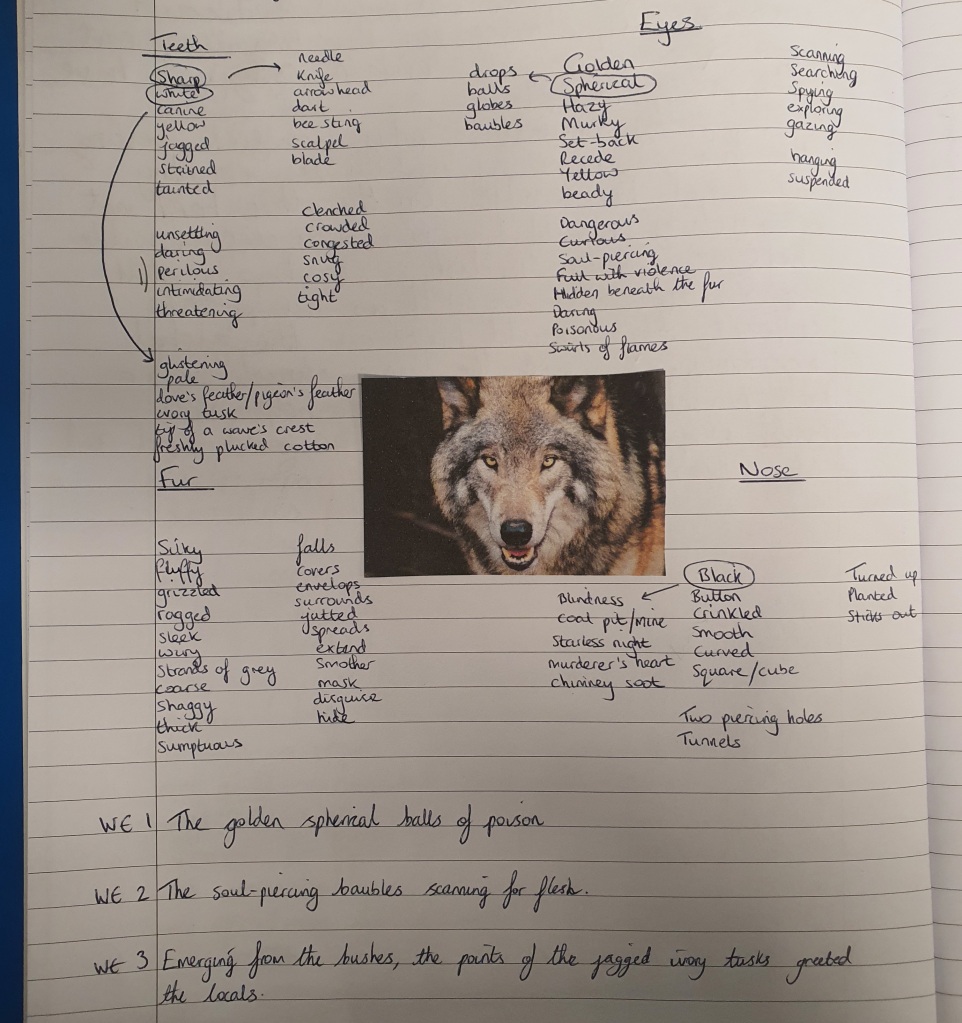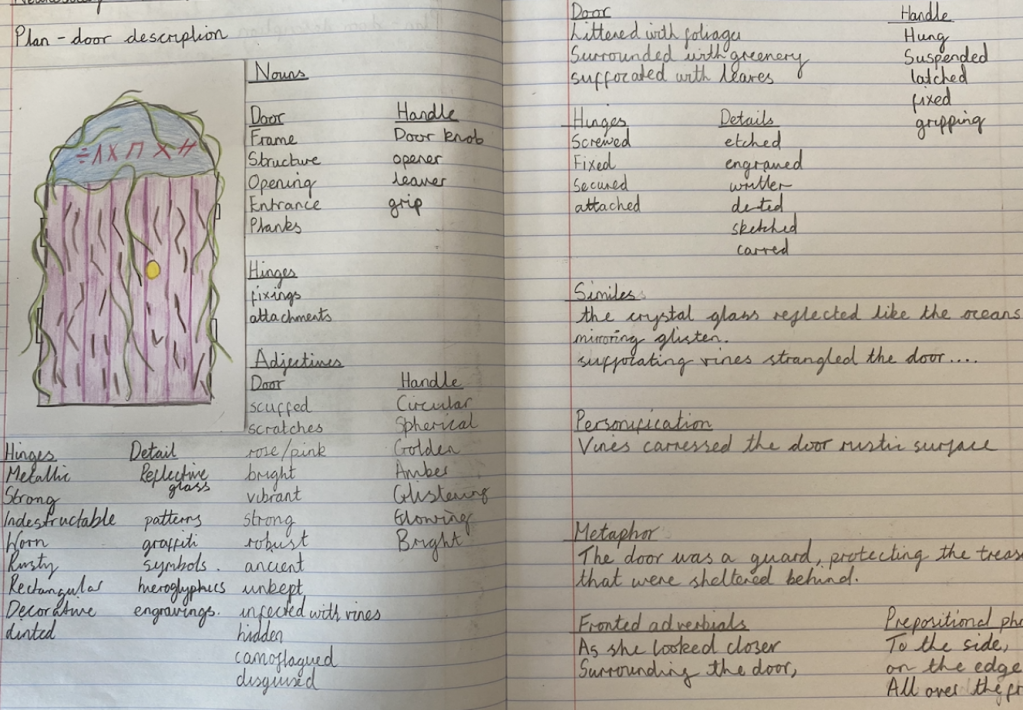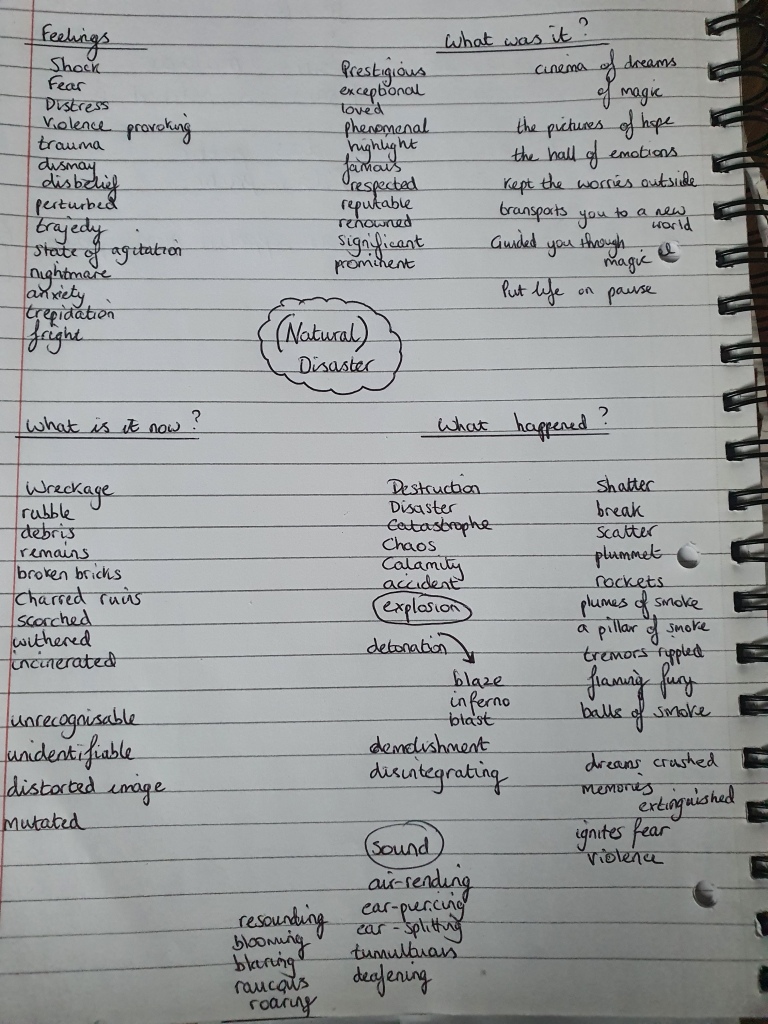
Delicious vocabulary


First and foremost, if you haven’t seen this BBC Radio 2 video recording of the famous Stephen Fry expressing the love of language, I urge you to watch it now.

I have always strongly advocated that writing is a form of art. Through recording our own thoughts and feelings via letters, diary entries, text messages and so on, to painting a mental realm of scenarios and adventures that lure us away from reality, it embodies personal, professional, political and societal views.

Isn’t is just fascinating how a sequence of logograms/ letters and words have the ability to convey meaning, manipulate, influence and connect with everyone. Do we explicitly share this admiration and awe of language with the children?

We should!

Quite often, whether it is pre-teaching vocabulary for the reading lesson or just sharing excitement for language, instead of asking the children to write down their “favourite word” from the pre-teach list, I am now more specific:

“Choose two words from the list that you like the sound and feel of.”

Followed by

“Now choose two words you like the meaning of.”

This is a wonderful way to discuss how the articulation of phonemes impact how we feel about saying the word whilst also implicitly revisiting the skills of phonics.

The feel can impact the feel

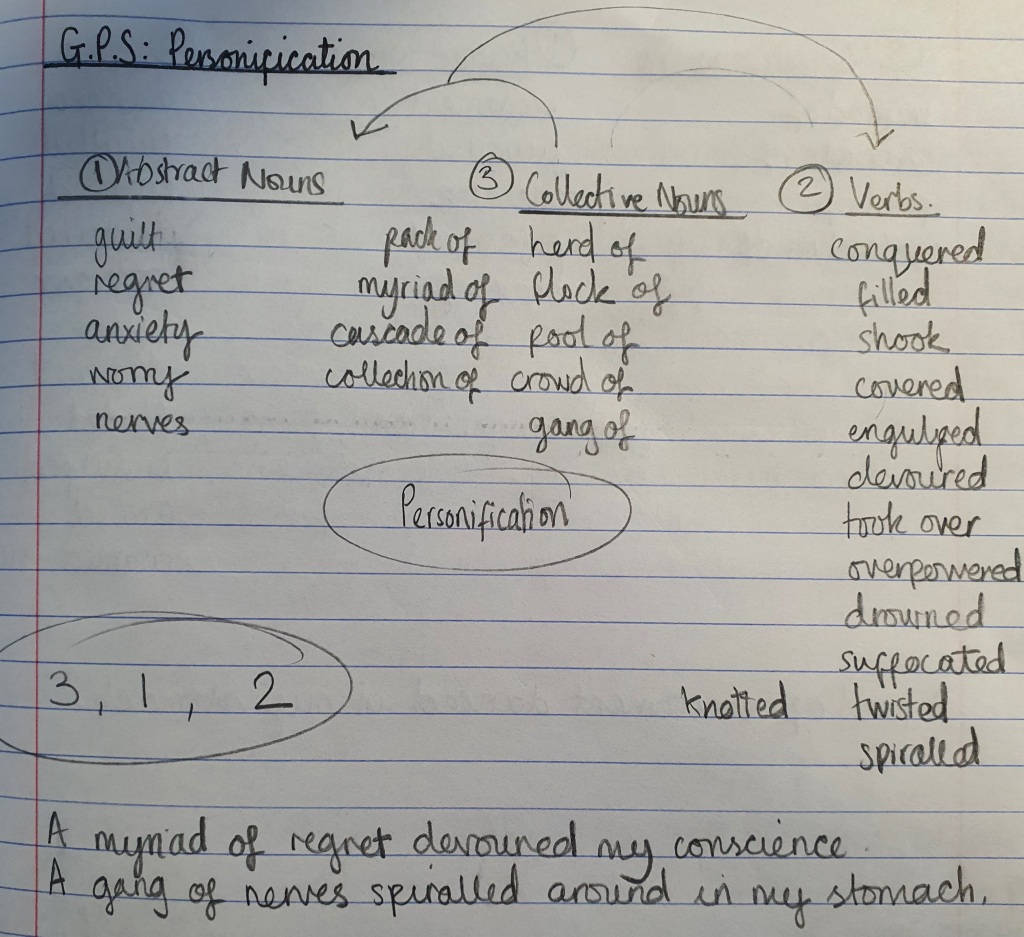
During a vocabulary lesson, I was capturing and recording the class’s vocabulary suggestions about a utopia VS a dystopia. The focus was on personification. So we broke the lesson down into focusing on the nouns first, followed by the verbs. However, for this lesson, we decided it would be the change of verb that would distinguish the description between the two settings.

The heading Nouns was at the top, centre of the page. To the left, was the heading Verbs (for the utopia) and on the right of the heading Nouns, was the heading Verbs (for the dystopia).

The outcome of the lesson was for the children to have a vocabulary bank that could be applied to both stimuli.

For example,

The noun: wind.

Utopia verbs: whistle, tickled, stroked.

Dystopia verbs: roared, pounded, annihilated

Before introducing the dystopia words, I wanted to share my love for vocabulary and explain how the feel of some words can impact the feeling of the writing.

“Show of hands, who has eaten a crunchy carrot before?” To which many hands went up, accompanied by the bemusement of this question.

“Ok, who has eaten a soft, chewy sweet before?” Many hands.

“What about a crispy roast potato?” Again, many hands and the odd ‘lick-of-the-lips’ from a few.

Although these may have appeared random to the children, there was a very good reason for it.

I explained how we all have a range of textures and tastes in our foods which many of us like, but if we had the same all the time, it would be a bit boring. For me, the same principles apply to vocabulary. Using the same words affiliated to a stimulus, over and over again, can be limiting; of course we want words to be retrieved and recycled but the aim is to broaden this spiral. So using a range is far more appetising: vocabulary is delicious!

Specific example

Think about describing a feather falling elegantly, the gentle sounds of /s/, /f/ and /t/ in some examples for the words softly, swiftly, swirl and twirl feel soft against the lips with high pitch tones that feel sweet and calming to articulate. Whispering and slow physical movements can support this convention of comfort and tranquility.

However, when wanting to describe the dystopia, sounds like /d/, /g/, /c/, /ct/, /st/ in this instance require harsher emphasis for words like destruction, detonation and eradication.

Of course, this isn’t a set rule for all words but spending time to analyse the physical feel of words can help children make associations (or disassociations) with meaning and spelling.

Everyday examples

During a pre-teach vocabulary session, words like simultaneous, grotesque and capricious were highlighted. By asking the children to choose their favourite feeling of the words, many chose grotesque and capricious. Grotesque because the /que/ sound felt satisfying at the back of the throat and capricious, because the quick snap of the /c/ followed by a soothing /cious/ sound felt nice. I was then able to show the children the association of the meaning of capricious with that contrasting feeling of /c/ vs /cious/; for example, the /c/ sound indicates a harsher feeling (a more aggressive mood) yet the /cious/ feeling made us feel the opposite (showing the immediate change of mood); this helped children grasp this meaning quickly.

Embedding this love for language as part of your minute-by-minute teaching and learning experience is just another way of exposing the children to high quality vocabulary.

One-Time
Monthly
Yearly

Make a one-time donation

Make a monthly donation

Make a yearly donation

Choose an amount

£0.50
£1.00
£2.00
£3.00
£9.00
£60.00
£3.00
£9.00
£60.00

Or enter a custom amount

£

Your contribution is appreciated.

Your contribution is appreciated.

Your contribution is appreciated.

DonateDonate monthlyDonate yearly

Moral Purpose

Whether you are new to teaching, an experienced teacher, or in fact, a professional of any kind, you should be sure to reflect, identify and articulate your moral purpose.

Your moral purpose is the epitome of all your decision-making; whether it is the reason you go to work, see your friends, partake in hobbies or spend time with family, these are the principles that govern your every decision. But sometimes we find ourselves questioning why we do what we do.

Relating this back to a school setting, a moral purpose is often centred around the children. Which seems obvious, right? But, depending on our experiences, beliefs and attitudes, we may find ourselves in the teaching profession for a whole host of reasons.

For those who are not involved in teaching, they may guess “It’s for the holidays,” or “You do it for the money,” (I am sure you consult your inner strength to stay composed to deal with this one), and maybe for a few, that is the case. However, for most, it has something to do with making a difference.

Some want to provide a better educational experience than the one they received; some want the chance to be able to broaden at least one child’s experiences; some find how a hidden part of them comes to life in the classroom setting; and some just love the interaction with curious minds. Whatever your reason is, be clear and true to yourself.

I often ask colleagues, new and current, what their moral purpose is. Quite often, I am issued with a small pause followed with an answer that lacks confidence and assertion. However, for me, I truly want the curtain to be unveiled to see what drives your minute by minute decision-making. It allows me to determine how receptive you will be to learning and feedback, how willing you will be to add value to the educational offer, and how determined you will be to overcome the number of changes and challenges that regularly come our way. And for the majority, the above is positively evident.

Knowing your moral purpose will not only help with explaining why you want to be a teacher or leader (for job interviews or simply reminding yourself why this is the profession for you) but will make most of your decisions, especially the difficult ones, must easier to make. You won’t be so worried whether you should suggest an idea or challenge one when you have your moral purpose propping you up: if you know it’s what’s best for your children, and it resonates with your moral purpose, you’ll have no issues fighting for it.

I have had many debates in the past about what is best for our children, but always upon reflection, I leave smiling with admiration about how passionate my team are to fight (constructively and professionally, I might add) for what they believe in – I am regularly in awe.

It also makes you more open to suggestions and support as you are far more prepared to try new things, seek new, innovative, efficient and effective methods as well as actively seeking feedback. I am often asking my colleagues to provide me with constructive feedback as it fuels my desire to improve as well as helping me to unpick my reflections and better my practice: and I daren’t defy my moral purpose!

A rabbit hole (you might be wondering), it’ll never be perfect! Surely the pursuit for the perfect classroom is a mirage? But that’s the difference between when I first started in education to where I am now: I am all about valuing and improving the journey, not seeking the destination. This brings variability into my practice, enhances my methods and keeps me enlightened to learning.

How wonderful is the thought that through a child’s journey, they will be under the wing of an array of inspirational teachers all governed by principles that have the child’s interests and development at its core. This is the culture we so long for.

Enriching the journey is better than rushing to the destination.

Know your moral purpose: the principles that make you, you!

One-Time
Monthly
Yearly

Make a one-time donation

Make a monthly donation

Make a yearly donation

Choose an amount

£0.50
£1.00
£2.00
£3.00
£9.00
£60.00
£3.00
£9.00
£60.00

Or enter a custom amount

£

Your contribution is appreciated.

Your contribution is appreciated.

Your contribution is appreciated.

DonateDonate monthlyDonate yearly
Complete the Circuit

In my blog “The Invisible Lead Balloon”, I highlighted a number of informed strategies that could be used to maintain engagement for learning. Once you feel confident employing these strategies, the next thing is to question, then decide, which are best to ensure children are engaged with learning.

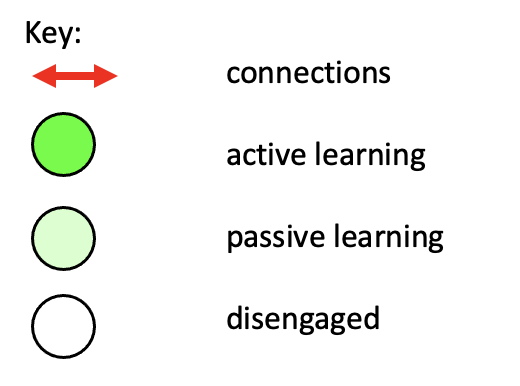
It is important to note that engagement doesn’t always result in ‘noise’; children can be fully engaged and immersed whilst silent. Through one of my regular, thought provoking conversations with @RumblesCandyce, we posed the analogy of learning being ‘electrical currents’. We all use and rely on many appliances that are powered by electricity. When you plug an appliance/ device into the wall, you know it is receiving electrical current to charge and/or operate it despite not being able to actually see the current. But you still know it is happening. For us, this is learning in action.

Below, I provide some images that could be useful for teachers to refer to when evaluating teaching and learning in their classroom.

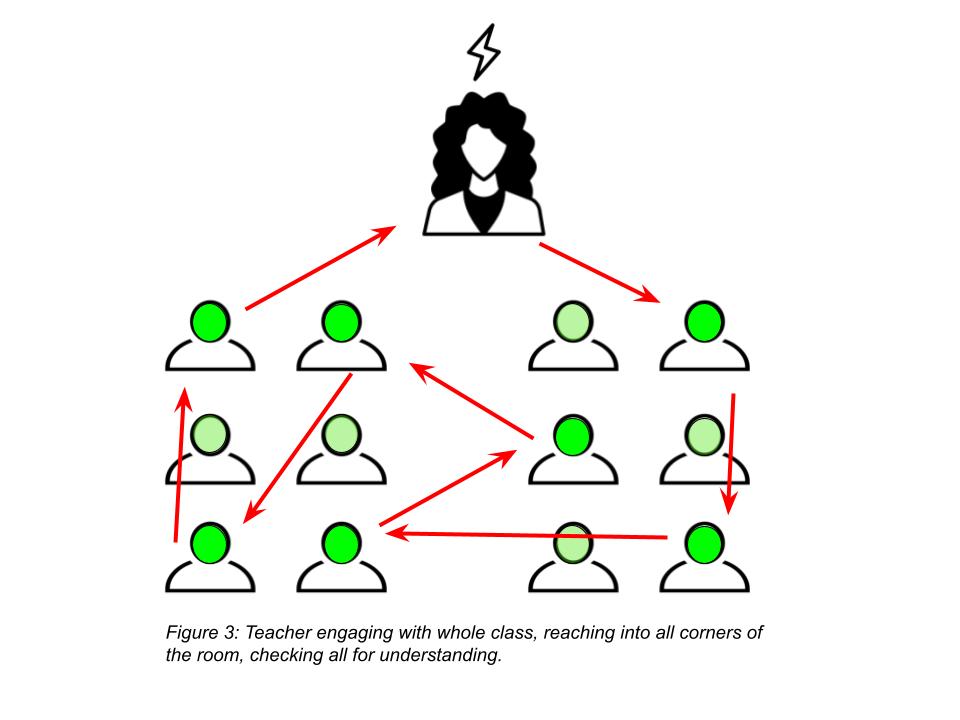
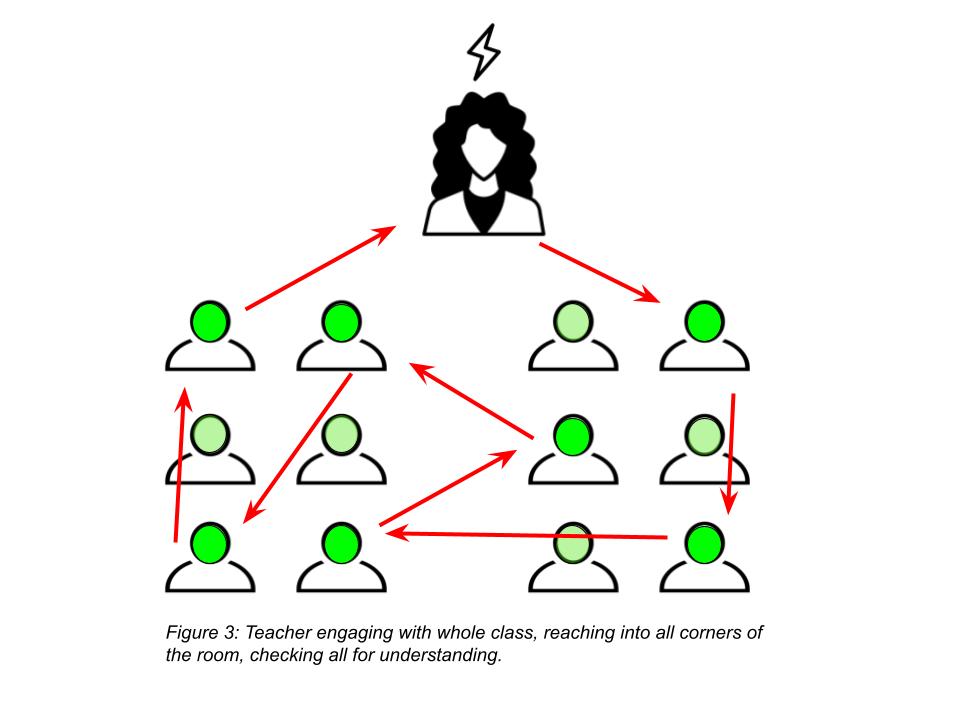
With the teacher being the electrical source and the children acting as the conductors, our ultimate goal is to ensure we create, establish and maintain strong, healthy, positive pathways (connections if I may) to allow the electrical current (learning) to flow. The teacher checks for understanding, thus, completing the circuit.

Small sparks: Where teachers may begin

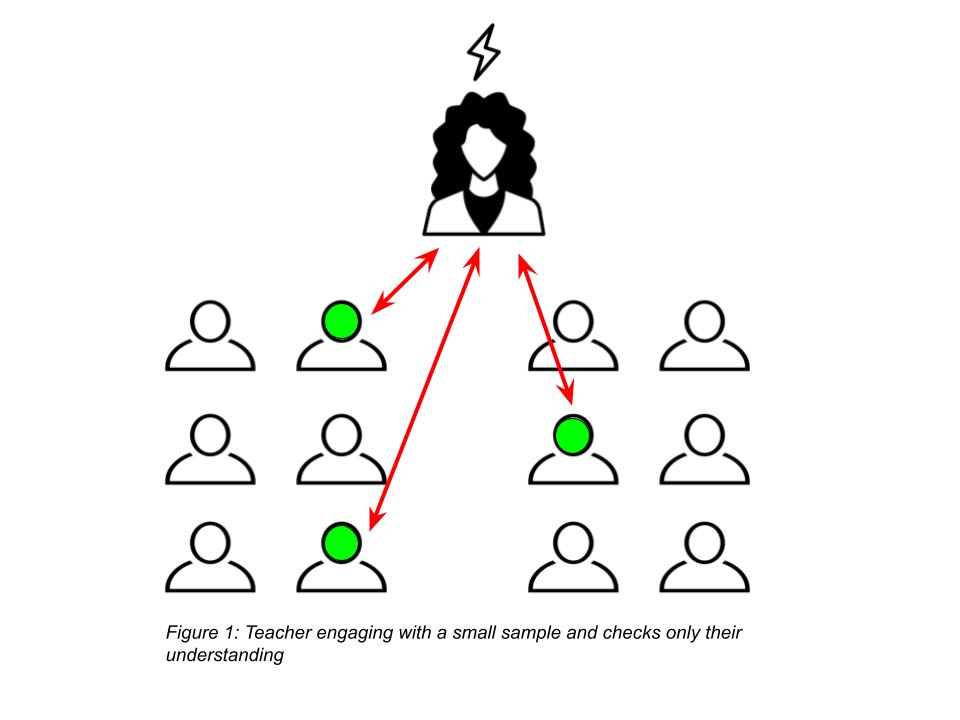
Consider Figure 1. A teacher delivers the input, interacts with one or two children (often the more confident ones) within their line of sight, and patrols only up and down the middle corridor of the class.  Only a few sparks for learning may be happening.

The teacher may use this small sample to inform whether there is a good level of understanding and whether their input is being interpreted as intended. As Dylan Wiliam explains in ‘What Does This Look Like in the Classroom’ (Hendrick and Macpherson, 2017), a “more serious issue, is that teachers are making decisions about what to do next with a class based on evidence only from confident students”. This would skew the validity of their assessment.

Being simply aware of our eye movements in the class can be a great starting point when improving practice.

Hendrick and Kirschner (2020) in ‘How Learning Happens’ highlight the work from Van Den Bogert (2016) where eye-movements of an expert and a novice teacher are tracked: “the larger the spot the longer the gaze; also, the opacity of the centre gives the intensity…” Without seeing the image example, the spots are representing all parts of the room, demonstrating the difference that experts tend to be able to scan the room frequently, not just glancing, and then zooming in to every child to check for understanding at different points.

More sparks: progress

Here in Figure 2, we now see the teacher begin interacting with pupils outside their centre line of sight. By interacting and checking for understanding from the front and other angles of the classroom, the teacher can gather a broader picture and spark further thought for learning. This encourages more actives learners (solid green) and influences those nearby (light green).

Circuit complete:

In Figure 3, we now see the teacher having a clearer sense of what is happening. This could be through active discussion and participation, or perhaps, children working silently but deep levels of thinking are evident. Through a number of strategies, the teacher checks understanding in all corners of the room, feeds the ‘student buy-in’ culture by allowing questions, discussions, collaboration and risk-taking, offering scaffolds and extensions where needed to keep the current flowing.

Interference:

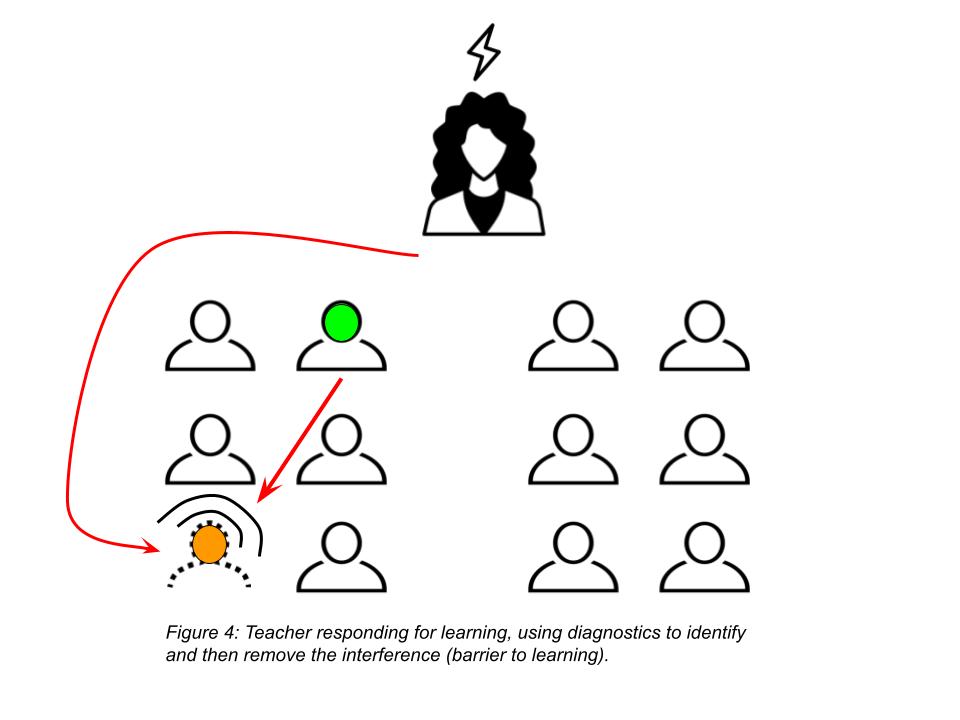
Now here we see the current affected: an interference.

Not everyone is conducting the current of learning.

This can appear as children struggling to answer, perhaps feeling the pressure of their peers, shutting down, or perhaps this is during a silent independent task and knowing your children well, you spot (even sense) someone who is stuck or trying to mask their understanding through a number of coping mechanisms. This is when you intervene!

Through the positive culture you have created, you can afford to compromise pace and provide them with more thinking time.

Within the open forum of your class, ensure you extinguish the pressure (for example, “I can see why you might be thinking hard here as it is an interesting point.”) but also thank the class “Well done everyone for waiting for James as I know you value what he has to say.”

Then consider the following below:

  • Provide stem sentences or multiple choice;
  • Remind them: “I (even better, we) value your thoughts”;
  • Lead them in “I was thinking this, do you agree? And why?”;
  • Ask them to say who they agree or disagree with;
  • Ask them to point to which part of the worked example they find difficult.

If still nothing, then consider the following to maintain the “No opt out” philosophy (Doug Lemov):

  • Allow them to write or draw their answer;
  • Share their idea with a partner or TA who could share aloud;
  • Give them more time to think about it – “Have a think about your sentence and then you can tell me when I come over.”
  • Get back on track with the lesson – move on to take the focus away.

Once you’ve got a contribution, be sure to hear it and express its value to the child; no matter how small it may be, I am sure you can find some value within it. Then encourage the strategies above (over time) in order for them to feel confident to contribute to the whole class.

Alternatively, if you notice this barrier to learning during independent tasks, this is where you provide your support, scaffolds, extensions and ensure you determine and deal with the cause of the problem, not the symptoms. For example, for a child not appearing to write anything for some time, rather than say “You should be writing”, determine why, strip it back, what is it they are stuck with and then support them as required. On the other hand, a child who is finished and staring our the window, provide them with your planned extensions, ask them to review, unpick, explain and improve. A child waiting for the rest of the class to finish is neither productive nor beneficial – this would suggest a performance orientated attitude to learning as opposed to Mastery.

New source:

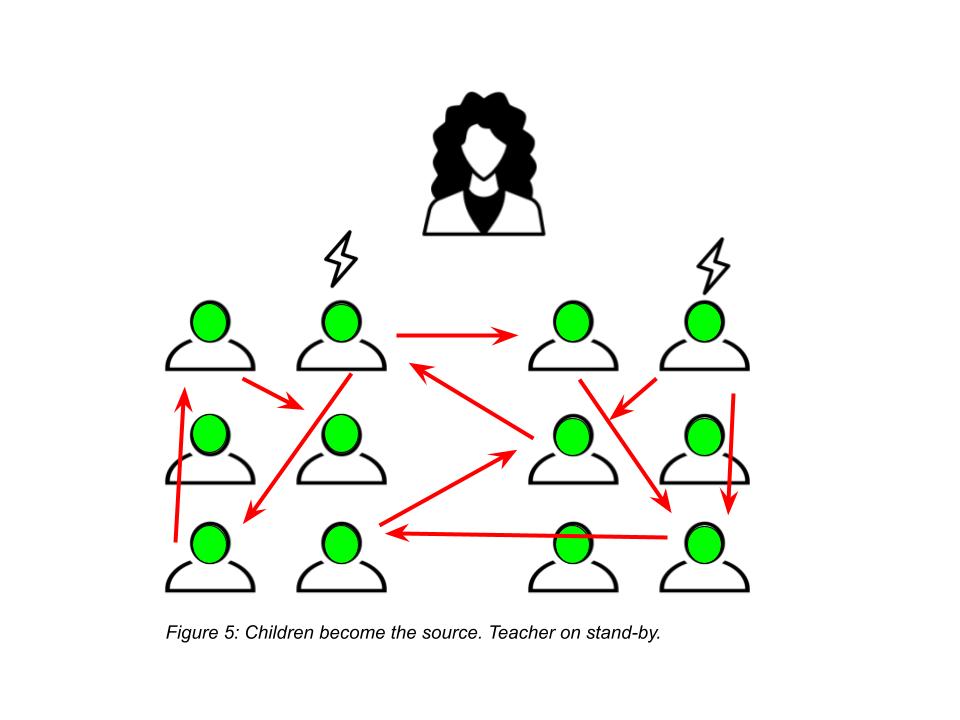
This is the ultimate goal: fuelling a new source. Children to take charge of their learning, lead the discussion, share their experiences, thoughts and achievements, whilst welcoming and valuing feedback. I am not suggesting children would lead a lesson; however, say in a Science lesson you have provided an image or video of how current flows through an electrical circuit (keeping in theme with this blog), in the positive and welcoming environment established, the child may say “Ah, that is similar to circulatory system.” This then sparks connections. Another child then adds “Oh yes, so the blood has to travel from the heart and go back to the heart to complete a circuit,” followed with “So then the organs could represent the components?” from another child. At this point, you can take it further by building upon it and using it as a new referencing through out the lesson.

As a teacher, this would be a golden moment.

One-Time
Monthly
Yearly

Make a one-time donation

Make a monthly donation

Make a yearly donation

Choose an amount

£0.50
£1.00
£2.00
£3.00
£9.00
£60.00
£3.00
£9.00
£60.00

Or enter a custom amount

£

Your contribution is appreciated.

Your contribution is appreciated.

Your contribution is appreciated.

DonateDonate monthlyDonate yearly
The Invisible Lead Balloon

We all know and understand the importance of careful, well-thought out planning and preparation that lays the stage for the magic of learning to happen.

I remember early on in my teaching career, I would spend a long time ensuring I had mitigated against the potential barriers to learning as well as the step-by-step progression of what I felt was needed (i.e. different types of questioning; appropriate tasks; effective deployment of TA etc.) in order for the intended learning outcome to be obtained. The lesson begins: I am feeling confident, prepared and determined I will shape the children’s learning one step further. However, mid-way through this particular writing lesson (generating vocabulary for a stimulus), I am struggling for contributions, needing more hands up, noticing the haze casting across the children’s vision. Fearing the lack of engagement, I provide some words in the hope this snow balls further, but no, it was like trying to get blood from a stone – engagement for learning was going down like a “lead balloon”.

Although there are a number of things I would do differently knowing what I now know from the abundance of research that is readily available to us all, I have found across my career, in both a teaching and leadership capacity, that these mid-lesson crisis moments happen. Quite often, this comes down to focusing too much on What do I need to do? as the teacher, rather than What do they need to do? as the learner. We need to blow engagement back into that balloon.

My general recommendation for a starting point would be the following:

  • Teach 3-5 minutes;
  • Practice (learner to digest/ have-a go) – Individually or in partners;
  • Check understanding – questioning, discussion etc. (general consensus);
  • Teach 2-4 minutes OR address (if needing to address, go back to step 1);
  • Practice;
  • Check understanding – (general consensus);
  • Independent practice;
  • Check understanding (individual);
  • Prepare to address (if needed) or extend.

The above would only be a starting point as these timings would change depending on the content and context; however, this process is generally a good starting point.

Indicators

First, we need to be aware of the indicators to check attention is present. This is what I like to call “Response for learning”. That moment when the deafening silence absorbs the children and dampens your spoken word. You’ll notice children begin to gaze across the room, doodle, perhaps hand-on-face, lowering themselves into the chair. Or perhaps in a group scenario, you notice passive learners, sitting back, with those more confident running the show. More often than not, the temperature in the room has increased; you’ll notice jumpers off, sips from their bottle, fanning themselves in extreme circumstances. And when you do start to choose children to contribute (how ever long this is since they have unintentionally switched off), there’s that panic from those around unsure of what was said, by whom and in reference to what. Of course, we ideally want to be proactive with our strategies that support learning, but realistically, time does get away from us so we need to be prepared to react promptly to the above.

Culture

Teacher-pupil and peer-peer relationships are key for engagement. As I heard from Doug Lemov discussing this with Craig Barton on Mr Barton Maths Podcast, “The children won’t care what we say, until they know that we care”. For me, this is the epitome of supporting children’s learning, especially those who find it difficult to engage. When we consistently model and promote positivity for collaboration, discussion, debate and explanations, children begin to realise this is truly the expectation of the room. Be mindful how you choose children because if you regularly choose children to prove whether they are listening or not i.e. John, can you tell me what we have just discussed as you appear to be taking “notes”…, your first question to those that are timid may be perceived as a reprimand rather than a genuine question of curiosity or an invite to the class discussion.

It’s evident that effective classroom strategies sit on a bed of positive culture.

  • Do the children feel safe to share?
  • Do the children feel valued?
  • Do the children know they will receive immediate feedback because you want them to improve, not just because they are wrong?
  • Is your body language and are your facial expressions welcoming and inviting?
  • Are you modelling how their answers can be used and responded back into the class or into the learning process?

Using some of the strategies below will contribute to this learning culture and hopefully begin the journey of shifting motivation from extrinsic to instrinic, with the hope of shifting from performance orientation to mastery orientation (Pintrich, 2000, cited in Kirschner & Hendrick’s (2020) ‘How Learning Happens’). You can also hear my thoughts and colleagues’ views on this book here.

Pace

For me, this is really important. With careful considerations to Cognitive Load Theory being in the quest to “Eliminate Extraneous Load and optimise Intrinisic Load” (Ollie Lovell), children regularly surprise me at how well they respond to faster inputs. This is, of course, dependent on their prior learning and complexities of the new learning, but in contrary to the complexities, if we have broken the learning down enough, it should be quicker and easier to absorb. With lesson designs, particularly like vocabulary generation and Maths fluency focus, the lesson can be moved on faster than perhaps a history or R.E lesson. Although, I would argue that you could still break down key dates, prominent figures, attributes etc. that could be retrieved, discussed, written down and explored in a timely manner. With the examples below, in some cases, I would employ as short bursts aiming for 10 seconds, 20 seconds being maximum. This helps me introduce a number of strategies throughout the lesson that keeps engagement high whilst not taking any longer than it needs.

  • Partner talk (see below).
  • Bounce off – Child A shares their thoughts, then they choose child B and so on.
  • Choose your best 3 that you like the meaning of.
  • Choose your favourite word that you like the feel and sound of when you say it.
  • Which date (or fact) sticks with you the most?
  • Which fact is harder to remember?
  • On a whiteboard, circle your favourite.
  • Point to left wall if you think X, point forward if you think Y etc.

Questioning

Similar to Dylan Wiliam’s remark about how he should have used the term “responsive teaching” rather than formative assessment (Hendrick & Macpherson, 2017), I refer to questioning in this instance as “Response to learning”.

Rosenshine’s ‘Principles of Instruction’ highlights “asking questions” and “checking for understanding” as two key principles. This is crucial in determining whether the children are/were engaged in the delivery and how they have understood and interpreted (Piaget’s theory of cognitive development: ‘assimilation’ and ‘accommodation’) that information. There are a number of ways to capture this information whilst maintaining engagement. Here are just some of many:

  • What is the 1 key thing you’ve remembered on your whiteboard?
  • What question can you think of?
  • Using fingers or whiteboard to engage in multiple choice (e.g. show me 1 finger for this word vs 2 fingers for this word being more effective)
  • Why do you think that?
  • Why is this better than Jane’s answer?
  • What have you noticed? (patterns with number, shape; root words, prefixes/suffixes; dictators across history)

The term “cold calling” is extremely prevalent at the moment (or ‘warm-calling’ when thinking about how it contributes to culture as referenced by Michael Pershan), although the practice has existed in many classrooms for years. Doug Lemov in Teach Like a Champion explains the premise behind this and what this looks like in practice. I’d highly recommend reading the TLAC blog and checking out Tom Sherrington’s blog.

Essentially, this does link to culture. Whether you choose to incorporate a “hands-down” approach or not, creating an environment where children feel confident to speak aloud, where mistakes are welcomed and risks encouraged is what will allow this questioning approach to blossom. At first, it will be daunting and you may have to invest lesson time but it will be worth it. Consider the perseverance as ‘short term gains are for the pessimist, long term gains are for the optimist’: a phrase that resonates with me, especially in leadership.

Partner talk

This is an element of cold calling but I am separating this to offer other strategies during this segment of learning. Being purposefully and already considering the seating plan, I want to encourage partner talk as another opportunity to digest. If they have understood correctly, they will regurgitate this information through their own words, providing their partner with now 2 explanations (excellent opportunities to promote oracy). This partner can then use this to support their own understanding. By sharing with the class what their partner has said will allow me to assess how well their partner has understood, how well they have understood, and taking it one step further, how well they understand by agreeing or disagreeing with their partner.

  • 5 – 10 seconds, choose, discuss, agree.
  • Share your favourite with your partner.
  • Share your weakest or most difficult to remember with your partner.
  • Give a tip to help your partner remember (it might not be the best tip, but that act of focusing on this could be enough).
  • Share with the class one point your partner has raised.
  • Share with the class one aspect you liked the most about what your partner has said.
  • With your partner, create a sentence using the following.
  • Give your partner an answer, they have to make the question.

Position

With an ongoing discussion about the effectiveness of displays in the learning environment, we are all aware that having a board cluttered with lots of examples, printed lettering and posters creates a ‘blur’ within the environment. I know if I swapped one poster or element for another on a cluttered display board, I would highly doubt anyone would notice unless using or looking at the board intensely. So by standing in the same position, I feel that sometimes we can blur into the environment too, especially when that “lead ballon” begins to lower.

Move around, get away from the “left-hand side of your board” or from behind your visualiser stand, or worse, the teacher chair, and patrol. Show the children you’re actively listening to responses, ideas and open a public forum where those less confident can ask you a quick question as you are passing by (what you do with this links back to culture).

Pause (refill the balloon)

After all of the above, you’re keeping the balloon afloat, all children are engaged but there can come a time when all that thinking and functioning of the working memory just feels too much. Pause! Give time for the children to talk with their partner to summarise, discuss and reflect: time to add air to that balloon.

I am yet to find enough evidence and research that explores what I perceive to be an example of cognitive fatigue, but what I do feel links in the concept of “Vigilance Decrement”. This is where the ability for the child to act and deal with signals (teaching input, discussions etc.) deteriorates. If children feel overloaded, learning will be hindered. So be mindful not to sacrifice learning at the expense of engagement.

Pedagogy

“We teach explicitly so I need to be telling them what they need to know.”

Whatever your views are and/or the pedagogy your school believes in, children still need to be engaged to receive the quality you are providing. Archer & Hughes (2011) in their book ‘Explicit Instruction’ highlight the fundamentals in eliciting responses: frequent responses; monitoring student performance; providing immediate feedback; and pace. Whether you prefer an inquiry approach to learning or explicit, direct instruction, you still need to employ the strategies that allow learners to learn, make sense of, deliberate, practise, question, argue and conclude.

There are a number of reasons and factors that constitute why lessons need to be teacher focused vs learner focused. Ultimately, the goal is for it to be learner focused, but I am aware of schools at different stages of their journey that need to focus on other priorities, such as behaviour, consistent teaching pedagogy etc. But, with the aim of all lessons to be effective for the learner, it is fundamental to consult your own classroom experience, experience of your colleagues in conjunction with other academics who provide a number of useful strategies. I would also recommend looking at the WalkThrus books (1 and 2) by Tom Sherrington and Oliver Caviglioli as these offer a number of useful strategies to enhance classroom practice. Use the examples above that best work for your children and ultimately, which will support the knowledge you intend the children to learn.

Have all the tools at your disposal to keep that “balloon afloat”.

One-Time
Monthly
Yearly

Make a one-time donation

Make a monthly donation

Make a yearly donation

Choose an amount

£0.50
£1.00
£2.00
£3.00
£9.00
£60.00
£3.00
£9.00
£60.00

Or enter a custom amount

£

Your contribution is appreciated.

Your contribution is appreciated.

Your contribution is appreciated.

DonateDonate monthlyDonate yearly